Learn How to Choose Diet Pills Supplements Safely
How to Choose Diet Pills Supplements without getting played? Start by assuming the bottle is selling you a fantasy until the formula proves otherwise. The problem is the weight-loss aisle is packed with flashy labels, weak evidence, and products that lean harder on marketing than on actual quality control.
Here’s the truth: a “natural” label is not a safety badge, “FDA approved” on a supplement page is usually nonsense, and fast-loss promises are where common sense goes to die. FDA says dietary supplements are not approved before they’re marketed, and NIH’s supplement guidance is blunt that safety depends on the ingredient, dose, and how it interacts with your meds or health conditions.
Table of Contents
- How to choose diet pill supplements safely
- Start with the label, not the hype
- Ingredients that deserve extra skepticism
- Red flags that mean walk away
- How to vet a product like a pro
- Bottom line
How to choose diet pill supplements safely
To choose diet pills supplements safely, ignore miracle claims and vet the formula like a skeptic: read the full label, avoid proprietary blends, verify third-party testing, check stimulant load, review interactions, and treat any product claiming fast, effortless fat loss as a red flag.
Check out this deep dive for more context.
NIH’s Office of Dietary Supplements says there is little scientific evidence that weight-loss supplements work, and NCCIH goes a step further: many rapid-loss products do not help people keep weight off long term, while some come with real safety concerns. That should immediately change how you shop. You are not looking for magic. You are looking for a product that is transparent, realistically dosed, and boringly honest. In this niche, boring is good.
If you have been browsing different appetite suppressant options, this is where people usually get trapped: they compare promises instead of comparing labels. That is backwards. Promises cost nothing. A clean Supplement Facts panel, a real ingredient list, and a manufacturer that leaves a paper trail? That is where trust starts.

Start with the label, not the hype
The label is the audit trail. If the front of the bottle screams “melt fat fast,” flip it over and read the part the marketing team hopes you ignore.
What a decent label looks like
First, check whether the label clearly lists every active ingredient and the amount of each. If it hides behind a “proprietary blend,” you do not know how much caffeine, stimulant extract, or filler you are actually getting. That is not edgy. That is sloppy. Also check serving size. Some products make a formula look stronger than it is because the daily dose requires four capsules, not one.
Second, look for claims that cross the line from suggestive to ridiculous. FDA says supplements are not pre-approved for safety and effectiveness before sale, and it also warns consumers not to confuse supplements with FDA-approved drugs. So when a bottle acts like it is a medical-grade fat-loss solution, that should set off alarms, not confidence.
Third, scan for basic manufacturing credibility. A serious brand should tell you where it is made, how to contact the company, and whether it follows quality standards such as GMP. Better yet, it should point to third-party testing. No proof? No deal.
Fast forward to the part most buyers skip: disclaimers and warnings. If a label says not to combine the product with other stimulants, not to take it if you have blood pressure issues, or not to use it with certain medications, believe it. That fine print matters more than the neon headline on the front. If you need a wider comparison set before buying, skim a few broader best diet pill roundups and compare the labels, not just the sales copy.
Ingredients that deserve extra skepticism
Not every ingredient is garbage, but some categories deserve a raised eyebrow the second you see them.
- Mega-stimulant stacks: caffeine plus multiple “energy” herbs and extracts can turn a basic supplement into a jittery mess.
- Proprietary blends: translation: “trust us, bro.” Hard pass.
- Exotic miracle botanicals: if the main selling point is novelty, not evidence, you are paying for story time.
- Pixie-dust dosing: a decent ingredient in a useless amount is still useless.
NCCIH notes that supplements marketed for rapid weight loss, including some heavily hyped botanicals, have not been shown to work for long-term weight control, and some have serious safety issues. NIH’s consumer fact sheet says sellers often claim these products block absorption, curb appetite, or speed metabolism, but the evidence is usually thin.
This is why I tell people to compare categories before products. If you are sizing up thermogenic formulas, spend a few minutes reviewing how typical fat burner formulas are built. Once you understand the usual stimulant tricks, weak labels become painfully obvious.
Red flags that mean walk away
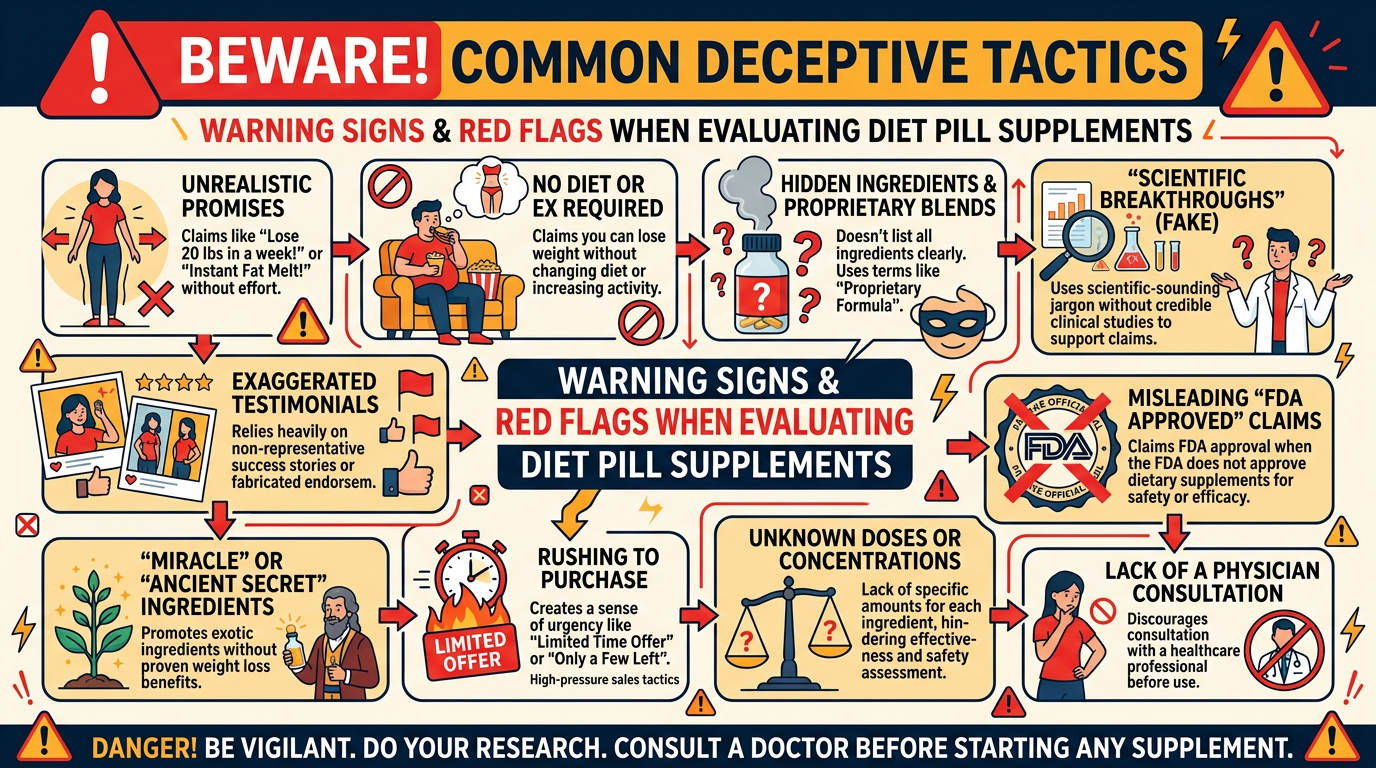
Bottom line: if the product sounds too good to be true, assume it is until proven otherwise.
- It promises fast, effortless, dramatic weight loss. That is marketing bait, not adult supervision.
- It says “FDA approved.” Supplements are not approved the way drugs are. That claim is either ignorant or manipulative.
- It hides ingredients. No full transparency, no sale.
- It has zero warnings despite being stimulant-heavy. Either the brand is careless or you are reading a fairy tale.
- It is sold like contraband on random social accounts or sketchy marketplaces. That is where the risk profile gets ugly.
FDA’s recent weight-loss product notifications warn that many products promoted as diet pills, fat-burning pills, and slimming teas are likely contaminated with dangerous hidden ingredients. FDA also keeps publishing notices about products found to contain undeclared drug ingredients such as sibutramine, which was removed from the market for safety reasons. That is not a minor technicality. That is the kind of shortcut that can seriously hurt people.
NCCIH also notes that a government study found 20 percent of 127 supplements marketed for weight loss or immune support made illegal claims. So yes, the supplement aisle has a quality problem, and pretending otherwise is how buyers get burned.
How to vet a product like a pro
The five-minute safety screen
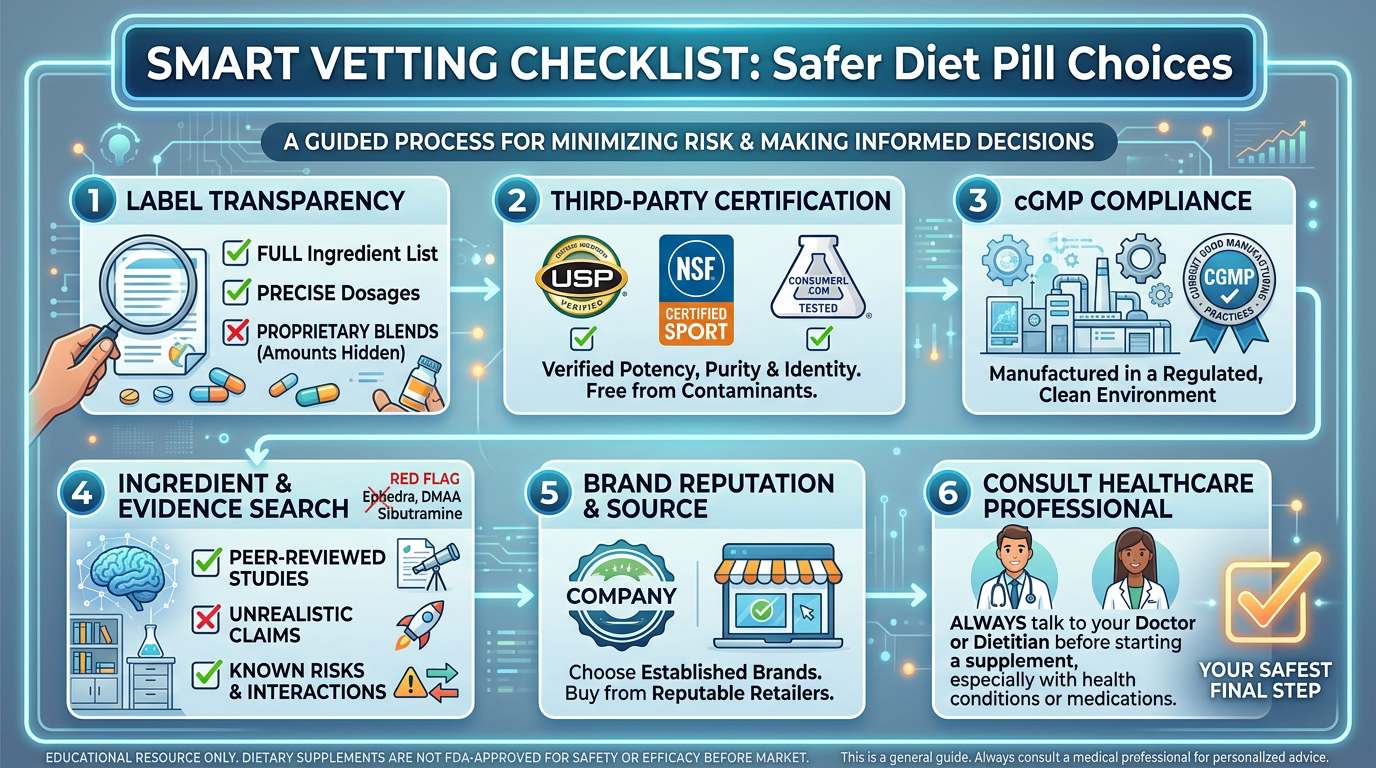
Use this checklist before you spend a dollar:
- Read the full Supplement Facts panel. If you cannot verify what is inside, stop.
- Check the dose. Look for ingredients that are disclosed clearly, not buried in blends.
- Search the brand plus “recall,” “warning,” or “FDA.” See whether the company has baggage.
- Look for third-party testing. Bonus points if the brand tells you exactly who did it.
- Review drug interactions. NIH recommends talking to your doctor or pharmacist because supplements can interact with prescription and over-the-counter medications.
- Ask what problem the product actually solves. Appetite? Energy? Water weight? Cravings? A vague product is usually a weak product.
If you are still narrowing options, compare your shortlist against broader best diet pill categories instead of obsessing over one flashy brand. You will make better decisions when you judge products by use case, ingredient transparency, and safety profile, not by who bought more banner ads.
One more thing: a supplement can be legitimate and still be wrong for you. Caffeine-heavy formulas can be a terrible fit if you are sensitive to stimulants, prone to anxiety, have heart rhythm issues, or already drink a heroic amount of coffee. “Works for someone on TikTok” is not a clinical standard. Never has been.
Good products tend to look almost boring on paper: straightforward ingredients, clear dosing, plain-English warnings, and no cartoonish promises. Bad products try to hypnotize you with before-and-after nonsense and mystery chemistry. The difference is usually obvious once you stop reading ads and start reading labels.
Bottom line
Here’s the insider takeaway: the safest way to choose a diet pill supplement is to buy like a skeptic, not like a hopeful late-night infomercial viewer. Favor transparency over hype, evidence over testimonials, and realistic expectations over fantasy math. Use government and NIH resources when you need a reality check, because marketers are not paid to protect you.
For deeper reading, the most useful starting points are the NIH Weight-Loss Dietary Supplements fact sheet, the FDA’s weight-loss product notifications, and NCCIH’s supplement safety guidance. They are less exciting than ad copy, which is exactly why they are useful.
Bottom line: if a bottle sounds like it was written by a casino barker, put it back on the shelf.
As an Amazon Associate, I earn from qualifying purchases.