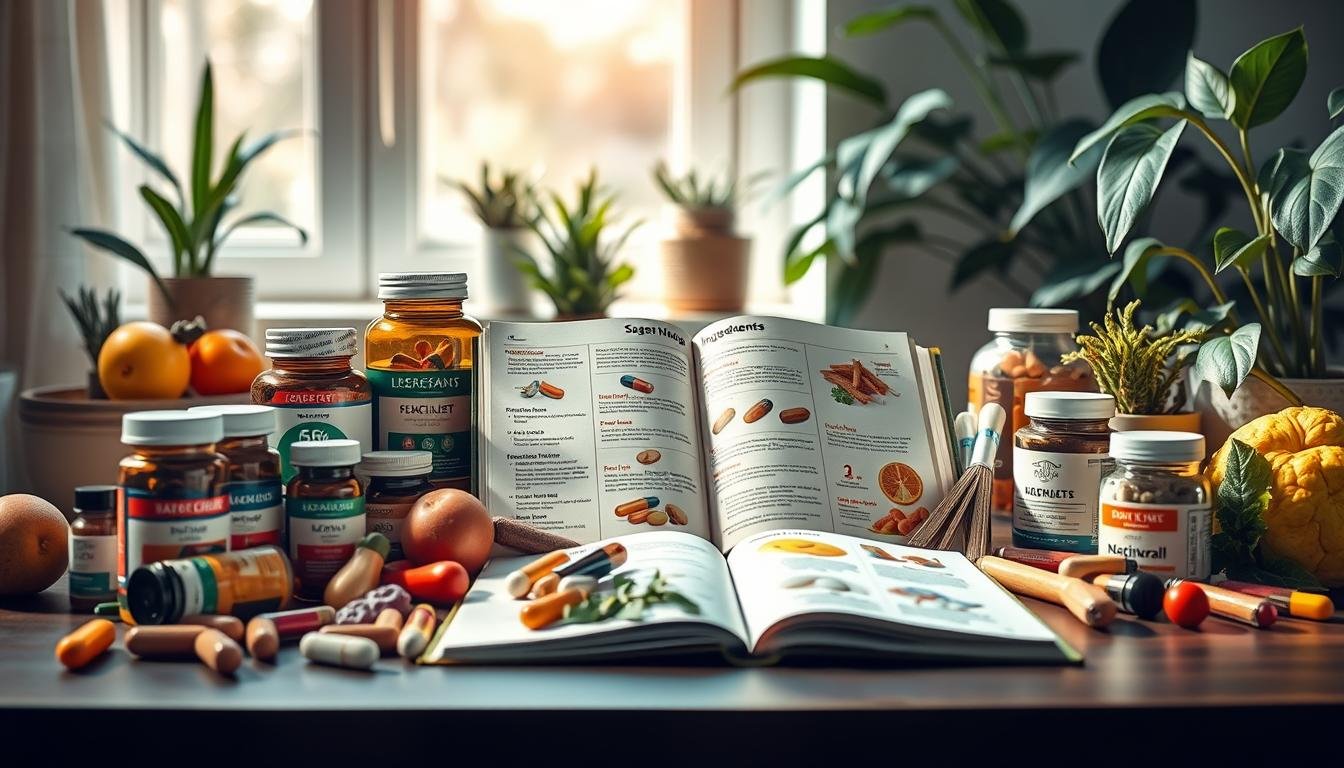
Hard to Understand Supplement Ingredients? This Simple Guide Fixes It
Have you ever stood in a store, holding two bottles that promise the same benefit, but have no idea which one to trust?
You are not alone. The sheer number of choices is overwhelming. With over 100,000 products available in the United States, picking the right one feels like a gamble.
The global market for these supplements was valued at $93.5 billion in 2024. It’s projected to reach $182.5 billion by 2032. To stand out, companies use fancy names and bold claims on their labels.
This makes it very confusing for people trying to make a smart choice for their health. An expert can spot a well-made product instantly. This guide aims to give you that same skill.
The market has great potential. It can help close nutritional gaps. Yet, it is also full of exaggeration. Minimal oversight means counterfeit items exist. Becoming an educated buyer is crucial.
We will break down labels step-by-step. You’ll learn to see past the marketing. We’ll look at real examples from actual brands. The strategies you learn can be used right away.
Always remember to seek professional guidance for personal advice. For a deeper look at evaluation, this independent guide offers useful insights.
Key Takeaways
- The supplement industry is vast and growing rapidly, creating a confusing landscape for consumers.
- Marketing claims and fancy ingredient names often obscure the true quality and contents of a product.
- Learning to read and interpret labels is an essential skill for making informed purchases.
- The market has both high potential for benefit and significant risks due to minimal regulation.
- This guide provides practical, immediate strategies to evaluate any supplement effectively.
- Proactive consumer education is the best defense against misleading claims and low-quality products.
- Consulting a healthcare professional is always recommended before starting any new supplement regimen.
Introduction to Supplement Ingredients
Two broad categories of components exist in every bottle: the active dietary ingredients and the functional ‘other’ ingredients. Knowing this split is your first tool for evaluation.
Understanding the Basics of Dietary Supplements
U.S. law defines a dietary supplement under the 1994 DSHEA. It is a product you swallow to add to your diet. It is not a meal replacement.
The active parts are called “dietary ingredients.” This term covers many substances. It includes vitamins, minerals, and herbs. Amino acids and probiotics also qualify.
Concentrates or extracts of these items count too. The “other ingredients” list includes fillers and flavors. These help make the pill or powder.
These products come as pills, gummies, or powders. Their goal is to support your body by filling nutritional gaps.
Why Ingredient Transparency Matters
This legal framework sets the stage. Yet, what’s on the label often differs from what’s inside. Studies find major mislabeling issues.
Some products contain none of the promised ingredient. Others have wildly incorrect amounts. Contaminants like lead are also a real concern.
Understanding the basics helps you spot these red flags. You can identify when a claim seems too good to be true.
The Landscape of Dietary Supplements in the United States
Navigating the supplement market requires understanding its dual nature. It offers immense promise for health but is filled with significant pitfalls.
Market Growth and Trends
Consumer demand drives explosive growth. The global supplements market was valued at $93.5 billion in 2024. It is projected to reach $182.5 billion by 2032.
Over 100,000 products fill U.S. shelves. This colossal space has real potential. It can help increase human lifespan and reduce harms from chronic diseases.
The Wild-West Nature of Supplement Claims
Unlike pharmaceutical drugs, these items face no pre-market FDA approval. This creates a regulatory gap. Manufacturers can launch supplements with minimal oversight.
The table below highlights the stark contrast in pathways to market.
| Pathway | Pharmaceutical Drugs | Dietary Supplements |
|---|---|---|
| Development Time | 8-12 years | Can be months |
| FDA Pre-Market Approval | Required (rigorous trials) | Not required |
| Success Rate to Market | 10-15% | No formal gatekeeping |
| Burden of Proof | On manufacturer | Largely on the consumer |
This environment attracts both science-backed and unscrupulous companies. Bold claims about health are common. The risk assessment falls to you, the buyer.
Understanding Labels: Navigating Front Label Claims
Your first impression of any supplement comes from its front label. This space is a strategic mix of essential information and clever marketing language.
Distinguishing between factual data and persuasive claims is a critical skill for any buyer.
Identifying Marketing Claims vs. Factual Data
Consider a real-world example from a reputable company. A Rhodiola rosea extract label shows useful facts. These include the brand name, exact botanical designation, capsule count, and serving size.
It also lists specific standardization percentages for active ingredients. This is valuable, factual data you can use.
Right beside this, you often find marketing claims. Phrases like “Maximum Strength” lack a clear comparison. Statements about supporting mood or performance may reference limited human research.
Even a claim like “Grown in Siberia” is often meaningless for that plant’s origin.
This blend exists because the U.S. market allows creative language on labels. One top-selling greens powder had a large check mark. The tiny text read, “Great tasting, approved by the founder’s mom.”
This shows how far claims made can push boundaries. Always approach front-panel things with healthy skepticism.
Your best move is to immediately check the standardized Supplement Facts panel on the back. This is where regulated, comparable data lives for all products.
Supplement Facts: Decoding Dosages and Content
Forget the flashy front label; the real story is told in the standardized panel on the back. The Supplement Facts box is the most valuable and heavily regulated section of any product label. Here, you find comparable data subject to FDA oversight.
Breaking Down the Supplement Facts Panel
By law, this panel must list specific data points. You will see the serving size and number of servings per container. It details all pharmacologically relevant ingredients and their exact amounts per serving.
The percentage of Daily Value (% DV) is shown where applicable. For example, NOVOS Core lists one serving as a single packet. A box contains 30 packets, a convenient one-month supply.
A typical three-column format displays the ingredient, its dose, and the % DV. Vitamin C might be listed as 100mg (111% DV). This means it provides more than the full daily requirement.
The FDA sets Daily Values to prevent deficiency, not for optimal health. They usually don’t assign DVs to botanical ingredients. This is why many compounds appear without a percentage.
Vitamins and minerals are listed toward the top. A thicker line often separates them from other active components below. These include botanicals and amino acids.
This section may also include serving suggestions and storage guidelines. Look for health warnings and brand contact information. This data is required for reporting serious events.
Regulatory Snapshot: FDA, DSHEA, and Ingredient Safety
The rules governing what goes into your vitamin bottle were largely set by a single law passed in 1994. The Dietary Supplement Health and Education Act (DSHEA) created the current framework. It treats these products differently from pharmaceutical drugs.
How FDA and DSHEA Influence Labeling
Under DSHEA, the Food and Drug Administration does not approve items before they are sold. This is a key difference from the drug approval process.
Manufacturers bear the burden for safety. They must notify the Food and Drug Administration about new dietary ingredients. This notification requires supporting data.
| Regulatory Aspect | Dietary Supplements | Pharmaceutical Drugs |
|---|---|---|
| Pre-Market Approval | Not Required | Mandatory (Rigorous Trials) |
| Burden of Safety Proof | On Manufacturer (Post-Market) | On Manufacturer (Pre-Market) |
| Manufacturing Standards | cGMP Regulations | cGMP Regulations |
| Primary Enforcement | Post-Market Surveillance | Pre-Market Review |
Current Good Manufacturing Practices and Quality Control
Current Good Manufacturing Practices (cGMP) are vital rules. They ensure quality, purity, and strength. All manufacturers must follow these procedures.
Firms are responsible for their products. They must ensure items are not adulterated or misbranded. Facilities must also register with the Food and Drug Administration.
Enforcement relies on inspections and monitoring. This system offers some protection. Yet, it requires informed consumers to navigate the market effectively.
hard to understand supplement ingredients
A major source of confusion stems from the distinction between a compound’s total weight and the actual amount of the active nutrient. Labels present this data in technically accurate but practically bewildering ways.
Common Misleading Claims and Their Implications
Consider a real-world example. A label might list “231mg Calcium (from Calcium Alpha-Ketoglutarate)” and then “1,100mg Calcium Alpha-Ketoglutarate.”
This does not mean 1,331mg total. The 231mg is the elemental calcium portion derived from the 1,100mg compound.
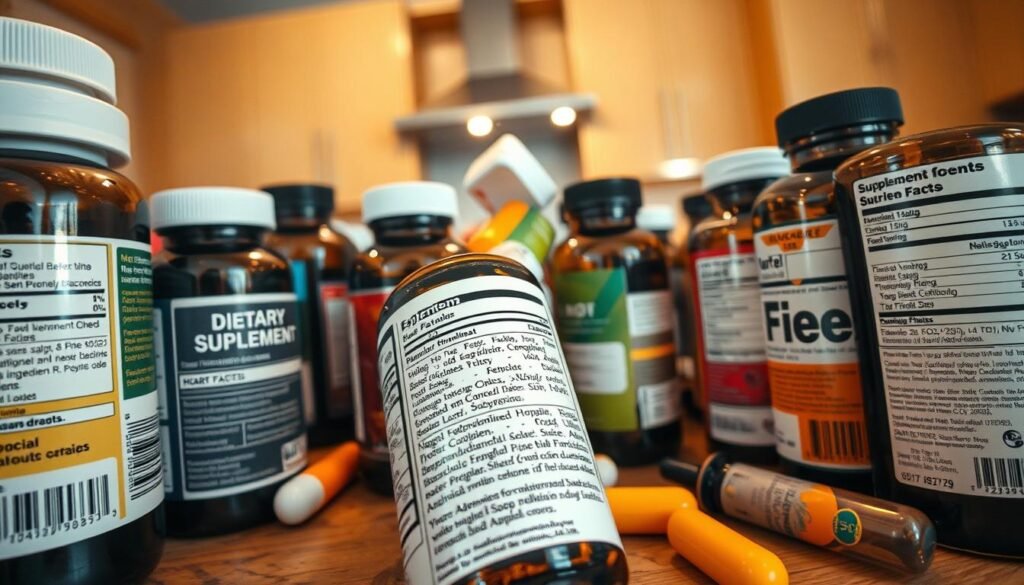
The 1,100mg represents a chelated form. It combines the mineral with alpha-ketoglutaric acid for better absorption. Raw calcium alone is poorly absorbed.
A similar pattern appears with magnesium. “1,700mg Magnesium Malate” provides 304mg of elemental magnesium. The rest is malic acid.
Examples of Confusing Supplement Labels
Different forms of the same vitamin have unique effects. Vitamin B3 is a key example.
The niacin form supports cardiovascular health but causes skin flushing. The nicotinamide riboside (NR) form is linked by research to mitochondrial health and aging, without flushing.
If a label just states “Vitamin B3” or “Magnesium,” you cannot know which form is used. This lack of specificity is a major red flag.
Your first step should be to contact the company’s customer service for clarification. Rely on official FDA guidance for understanding your rights.
If they cannot provide clear information about their ingredient forms, avoid that product. Transparency is a cornerstone of quality.
Evaluating Ingredient Quality and Potency
Beyond the basic ingredient list, the true measure of a product’s effectiveness lies in its concentration and standardization.
Extracts, Standardization, and Proprietary Blends
An extract is a concentrated form of bioactive plant compounds. A 10:1 ratio means 100mg equals 1,000mg of raw material.
Some companies use creative labeling. They might list 60mg of a 10:1 extract but imply a full 600mg dose.
Standardized extracts guarantee a specific percentage of active compounds. This ensures consistent potency in every capsule.
Proprietary blends list only total weight. They hide individual amounts, making efficacy impossible to verify.
| Branded Extract | Standardization | Key Features | Research Backing |
|---|---|---|---|
| Sensoril | Up to 10% withanolides | Root & leaf extract | Moderate clinical studies |
| KSM-66 | At least 5% withanolides | Root only, widely studied | Strong research for stress |
| Shoden | 35% withanolides | High potency, may be too strong | Emerging evidence |
Branded vs. Unbranded Ingredients
Branded ingredients like those above have published research. They offer quality assurance worth the premium.
Prioritize items with clear standardization and full dose transparency. Contact customer service if information is unclear.
Avoid any company that cannot provide complete answers about its ingredients.
Deciphering Dosage and Serving Sizes on Labels
One of the biggest tricks in the industry involves serving sizes that don’t match scientific evidence. Many producers use amounts far below what research supports.
This practice keeps costs low for making, packing, and shipping. Yet, it cheats you out of real benefits. The label may list a valuable component, but the dose is too tiny to work.
You must compare the listed amount against published human studies. This tells you if you ‘re getting a quantity shown to help.
For example, human trials on L-theanine consistently use 200mg. A product with only 50mg is unlikely to deliver results. One with the full 200mg is far more credible.
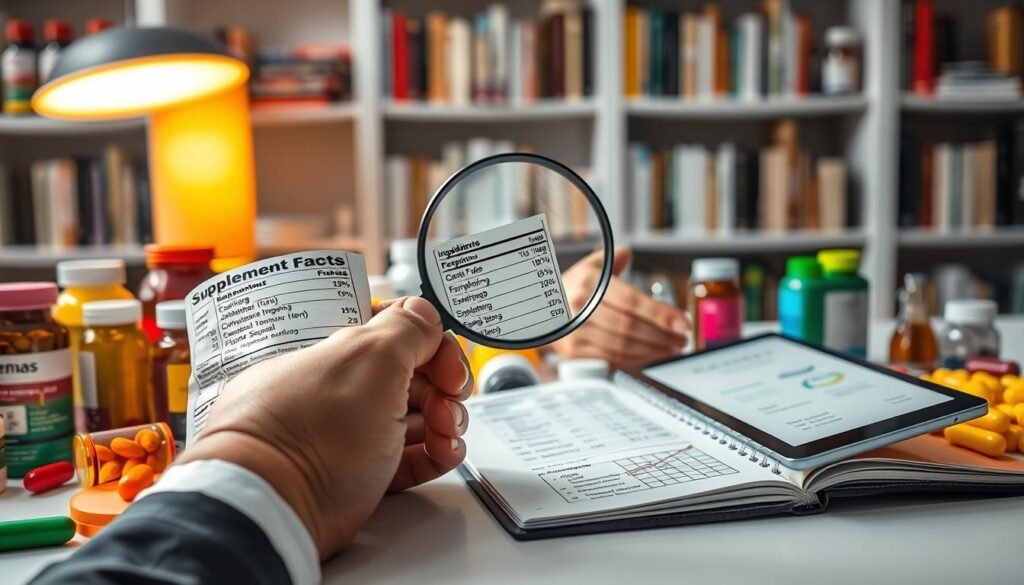
There are no rules for how a serving is defined. A company decides this alone, with no FDA review. One bottle may say a serving is one capsule, another says two.
This makes comparing prices tricky. You must calculate the cost per dose of the active ingredient. Do not just look at the container’s total price.
Use tools like Google Scholar to find effective doses. Check what was used in successful trials. Then verify your supplement meets that minimum.
Be wary of products with very small servings or many servings at a low price. This often signals a formula with token amounts. A trustworthy supplement will match its label claims with proven research.
The Role of Scientific Research and Clinical Trials in Supplement Efficacy
Distinguishing between hype and genuine benefit requires a critical look at the clinical research behind the formula. The evidence supporting a product’s claims is what separates science from speculation.
Assessing Study Quality and Relevance
Pharmaceutical drugs undergo a rigorous, multi-year trials process. This includes preclinical lab studies and multiple phases of human clinical trials. The entire timeframe averages 8-12 years.
In stark contrast, dietary supplements face no mandatory testing requirements before they are sold. The burden of proof shifts dramatically.
| Aspect | Pharmaceutical Drugs | Dietary Supplements |
|---|---|---|
| Pre-Market Human Trials | Mandatory & Multi-Phase | Not Required |
| FDA Review for Efficacy | Comprehensive | None |
| Typical Development Timeline | 8-12 Years | Can Be Months |
When evaluating studies, prioritize peer-reviewed work with large sample sizes. Look for double-blind, placebo-controlled methodology. Meta-analyses that combine results from multiple studies offer the strongest evidence.
It is crucial to check if the research was conducted on humans. Animal or test-tube studies often produce results that do not translate to people.
For example, Rhodiola rosea is marketed for stress and fatigue. Much of the supporting evidence comes from animal research. Only about ten human trials specifically target physical and mental fatigue.
Use resources like Google Scholar to find published studies. Verify that the specific form and dose in your product match what was used in successful human trials. A single positive study is not enough; look for consistent findings over time.
Many products cite research on branded ingredients but contain inferior versions. Confirm the efficacy claims by checking the actual evidence.
Risks, Safety, and Transparency in Dietary Supplement Marketing
Alarming research reveals widespread contamination and fraud in the industry. The crucial lack of FDA pre-market approval has created a wild-west marketplace.
Audacious health claims and misleading data are common. Potentially toxic substances can harm consumers who trust store shelves.

Potential Dangers of Under-dosed or Misleading Ingredients
One study of sports and performance dietary supplements found 14% to 50% contained anabolic agents. These prohibited substances pose serious risk for athletes and people with certain conditions.
Nearly 90% of sports products were inaccurately labeled. Of 57 tested, 40% had no detectable amount of the labeled ingredient.
Actual quantities ranged from 0.02% to 334% of daily amounts. This makes effective dosing impossible and creates a major safety concern.
A study of 156 prenatal vitamins found 83% contained lead. 73% had cadmium, and 25% contained endocrine-disrupting phthalates.
These products target vulnerable populations during critical health conditions. Yet, they can harbor dangerous toxins.
Counterfeit versions are another major risk. Legitimate companies like NOW Foods reported 11 fake versions in 2023.
These contained fillers like rice powder and trace amounts of generic Viagra. This could cause serious cardiovascular issues for unsuspecting users.
Under-dosed supplements present dangers beyond simple ineffectiveness. People may delay seeking medical care for serious disease.
They might neglect dietary improvements that would actually benefit their health. This false sense of security is a real problem.
The best defense is choosing transparent dietary supplement brands. Look for third-party testing and full ingredient disclosure.
Select companies with traceable lot numbers and scientific advisors. They should provide documentation for all disease risk reduction claims.
Becoming a Proactive and Informed Supplement Consumer
True empowerment in the supplement aisle comes from combining professional guidance with your own research skills. This final step transforms you from a passive buyer into a confident decision-maker.
Strategies for Effective Research and Verification
Always start by consulting your doctor or pharmacist. They can check for dangerous interactions with your medications or health conditions.
Next, verify product quality. Look for seals from NSF, USP, or ConsumerLab. These mean a third party tested the contents.
You’re getting what the label promises. Choose brands with traceable lot numbers and scientific advisory boards.
Buy directly from the manufacturer or authorized sellers. This avoids counterfeit supplements that waste money and risk your health. Our evaluation methodology details these verification steps.
Using Trusted Sources for Reliable Information
Your healthcare provider ensures the dosage is right for your body and needs. They help you time intake for maximum benefit.
Some supplements work best with food, others on an empty stomach.
For research, trust peer-reviewed human studies. Look for large sample sizes and double-blind, placebo-controlled designs.
Animal studies rarely predict results in people. This proactive approach protects you and ensures your regimen delivers real value.
Conclusion
The final step in mastering dietary supplement selection is applying your new skills. The market offers real benefits for your health but also contains risky products.
Proper, targeted supplements can help meet health goals. Your education is the best defense. It helps you get the most benefit while avoiding side effects.
Scrutinize front labels for marketing versus facts. Carefully read Supplement Facts panels. Verify doses against human research.
Understand ingredients forms for absorption. Seek standardized extracts and branded components. Avoid proprietary blends that hide doses.
Purchase from reputable direct sources. Choose supplement companies with third-party verification. Maintain a relationship with your healthcare provider for personal order.
You now possess the knowledge to navigate this space successfully. For continued support, explore resources for informed buying decisions on supplements.