5-HTP for Weight Loss: How It Reduces Cravings, Evidence & Safe Use
If you’re looking into 5-HTP for weight loss, you’ve probably already seen the promises. “Melt fat while you sleep.” “Kill cravings overnight.” Every supplement aisle is full of them. So here’s a different kind of pitch. I’m not going to tell you 5-HTP is magic. I’m going to tell you exactly what the research on 5-HTP and weight loss shows — the good and the shaky. Then you decide. Because the truth about 5-HTP is more interesting than the hype. And a lot more useful.
Does 5-HTP work for weight loss? Small clinical studies suggest it can. In several trials, 5-HTP reduced appetite, helped people feel full sooner, and led to modest weight loss of roughly 3 to 5 pounds over a few weeks. But the studies are small, old, and short, so strong proof is still missing.
Table of Contents
What Is 5-HTP and How Does It Work?
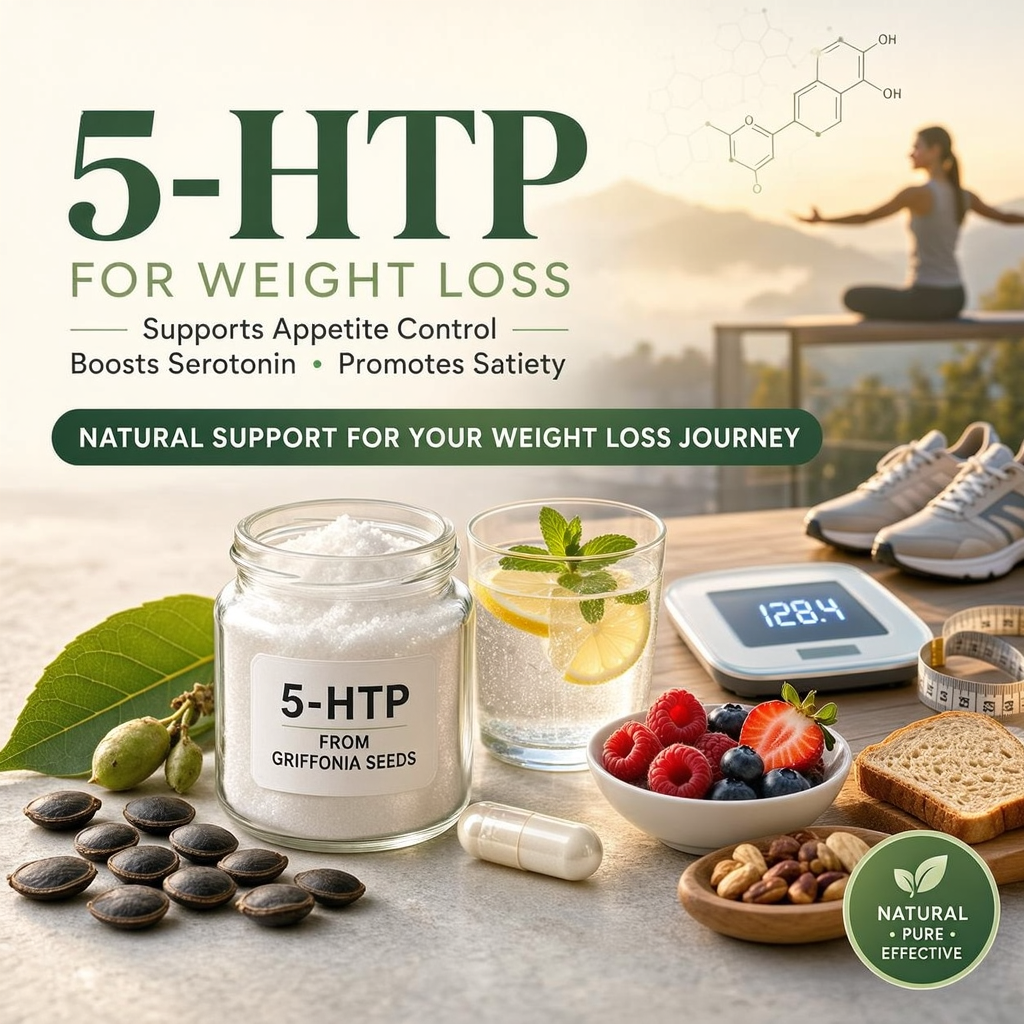
5-HTP is a building block your body already uses. Your body makes it from an amino acid called tryptophan. Then it turns 5-HTP into serotonin. Serotonin is the “feel full” and “feel good” chemical. It does a lot of jobs. One of them is telling your brain you’ve eaten enough.
That last part is the whole story here. If serotonin helps you feel full, then more serotonin might mean you eat less. That’s the basic case for 5-HTP as a natural appetite suppressant.
The supplement version of 5-HTP comes from the seeds of an African plant called Griffonia simplicifolia. Fun fact: eating tryptophan-rich foods doesn’t raise your 5-HTP much. That’s why people take it as a supplement instead.
How 5-HTP Affects Appetite and Serotonin
Here’s the part critics skip. The serotonin-and-appetite link isn’t some fringe theory. Some of the most famous diet drugs ever made worked on serotonin too.
One was fenfluramine — the “fen” in fen-phen. Another was lorcaserin, which the FDA approved for obesity in 2012. Both helped people lose weight. And both were later pulled from the market. Fenfluramine caused heart problems. Lorcaserin was linked to a cancer risk years later.
But notice what that tells us. The mechanism was real. Serotonin-based appetite control isn’t wishful thinking. It’s a proven target that drug companies spent millions chasing. 5-HTP takes a gentler road to the same place. Instead of a strong drug, it gives your body a natural ingredient to make more serotonin on its own.
5-HTP Weight Loss Studies: What the Research Shows
Now for the evidence. This is where I stay honest with you. The strongest studies on 5-HTP and appetite are decades old. Most came from one group of Italian researchers at the University of Rome and the University of Pavia in the late 1980s and 1990s. And here’s the thing — the results were consistent, and they were published in real peer-reviewed journals, not supplement brochures.
Let me walk you through the main ones.
Ceci (1989): 5-HTP and Early Satiety
Published in the Journal of Neural Transmission, this double-blind study gave 5-HTP to 19 obese women for five weeks. They ate less. They felt full sooner. Several reported early satiety — meaning they hit “I’m done” faster than normal. Average weight loss was just over 3 pounds in five weeks, without dieting on purpose.
Cangiano (1992): 5-HTP and Calorie Intake
This double-blind trial in The American Journal of Clinical Nutrition put 20 obese patients on either 900 mg of 5-HTP a day or a placebo. The 5-HTP group cut their calorie intake and lost weight compared to placebo. They also naturally reduced carbs.
Cangiano (1998): 5-HTP in Type 2 Diabetes
This one, published in the International Journal of Obesity, used people with type 2 diabetes. Over two weeks, the placebo group didn’t lose weight. The 5-HTP group lost 4.6 pounds — and ate significantly less carbohydrate and fat.
Rondanelli (2009): A Sublingual 5-HTP Spray
Also in the International Journal of Obesity, this trial had overweight women use a 5-HTP product placed under the tongue. It reduced appetite, lowered their BMI, and shrank skin-fold measurements.
See the pattern? Different researchers. Different people. Same result. Less appetite, less eating, some weight loss. That kind of repeat finding is not nothing. When separate studies keep landing in the same place, it’s worth paying attention.
What 5-HTP Feels Like for Appetite Control
Here’s what people who’ve actually used 5-HTP describe. And it lines up with the science.
It’s not that the weight vanishes. It’s that the fight gets quieter. The constant pull toward the fridge softens. The second helping stops feeling urgent. You finish a normal plate and just… feel done.
That’s the satiety effect the studies measured. Early fullness. Less drive to keep eating. For people who feel like their appetite runs the show, that shift can matter more than any number on a scale.
If you’ve ever white-knuckled a diet and lost, you know the real enemy isn’t willpower. It’s the hunger signal that never turns off. This is the exact signal 5-HTP seems to touch.
5-HTP for Weight Loss: The Honest Caveats
I promised you the shaky parts too. Here they are. Skipping them would insult your intelligence.
The studies are small. Many had 20 people or fewer. Small studies can mislead.
They’re old. Most are 25 to 35 years old. We badly need fresh, large trials.
They’re short. Weeks, not years. We don’t know if the effect holds long-term.
Nausea is common. Some people feel queasy on it. That alone could reduce eating — so part of the “appetite” effect might just be a mild upset stomach.
No huge modern trial has confirmed it. In fact, European food-safety regulators who reviewed the 5-HTP satiety claim concluded the evidence wasn’t strong enough to confirm it. The big, definitive study everyone would want doesn’t exist yet.
Anyone selling 5-HTP as a miracle is ignoring all of this. I won’t.
5-HTP Side Effects and Safety Warnings
This matters more than the weight loss. Please read carefully.
5-HTP raises serotonin. So do many antidepressants — SSRIs, SNRIs, MAOIs, and others. Mixing them can be dangerous. Too much serotonin can cause a condition called serotonin syndrome. It can be serious.
So if you take any antidepressant or mental health medication, do not touch 5-HTP without talking to your doctor first. This isn’t a suggestion. It’s a hard line.
There’s also a piece of history worth knowing. In 1989, a bad batch of a related supplement called L-tryptophan got contaminated during manufacturing. It made a lot of people seriously ill. The cause was the factory process, not the supplement itself. Still, it’s a lasting reminder: quality and sourcing matter. Cheap, sketchy supplements are a real risk.
The takeaway isn’t “avoid 5-HTP.” It’s “respect it.” Treat it like something with real effects — because it has them.
Who Should Consider 5-HTP for Weight Loss?
Let me be specific instead of vague. 5-HTP is most interesting for a certain kind of person.
You feel like your appetite is the main thing sabotaging you. You reach for carbs and sweets when stressed. You do fine at meals but lose control on snacks. You’ve tried “eat less” through pure willpower and it failed.
If that’s you, the appetite angle is worth a real conversation with your doctor.
If your challenge is something else — say, you eat reasonable amounts but the weight still climbs — 5-HTP is probably not your answer. Be honest with yourself about which camp you’re in.
5-HTP Dosage: How People Typically Take It
I’m not prescribing anything. But here’s what the research and common practice look like, so you’re informed.
Studies used a range of doses, often building up over time. In the trials above, that ran from a few hundred milligrams up to about 900 mg a day. Taking it before meals lines up with the “feel full sooner” goal.
Many people start with a low 5-HTP dosage to see how their stomach handles it, since nausea is the main complaint. More is not better. Higher serotonin isn’t automatically safer or more effective. The goal is a gentle nudge, not a flood.
And 5-HTP is a helper, not a replacement. It might quiet your appetite. It won’t build your habits for you. The people who see results pair it with real food choices and movement.
5-HTP for Weight Loss: The Bottom Line
Here’s the thing about 5-HTP for weight loss. Nobody can promise you it works. The studies are small, old, and short — and I’m not going to pretend otherwise. But the pieces fit. Serotonin really does control hunger; the big diet drugs proved that. And every small trial keeps pointing the same way: less appetite, less eating, a few pounds gone. Most diets die on the one thing 5-HTP actually seems to touch — the hunger signal that never shuts up.
So if appetite is the thing beating you, this belongs on your shortlist. Not as a miracle. As a maybe.
Do one thing this week: take five minutes with your doctor or pharmacist, bring this article, and ask if 5-HTP fits you and your medications. Do that before you spend a cent on anything.
This article is for information only. It is not medical advice. Talk to a qualified healthcare provider before starting any supplement, especially if you take medication or have a health condition.