Psyllium Capsules vs Powder for Appetite: A Practical Guide
Images in this article are AI-generated editorial illustrations, not documentary photographs or evidence of product testing.
One bottle counts capsules. Another counts scoops. Both promise fiber, yet the amount you actually swallow can be very different. If you are comparing psyllium capsules vs powder for appetite, start with the back label: the fiber type, grams per serving, and directions matter more than the format.
The practical answer: powder can deliver more psyllium in one labeled serving, while capsules avoid the drink’s texture and mixing. Neither format guarantees weight loss. Choose a product you can use safely and consistently, without exceeding its directions to copy a research dose.
This guide is for adults comparing U.S. products. It explains the evidence, the arithmetic, and the everyday trade-offs. It is educational information, not an individual treatment plan.
Table of Contents
Psyllium capsules vs powder for appetite: what changes?
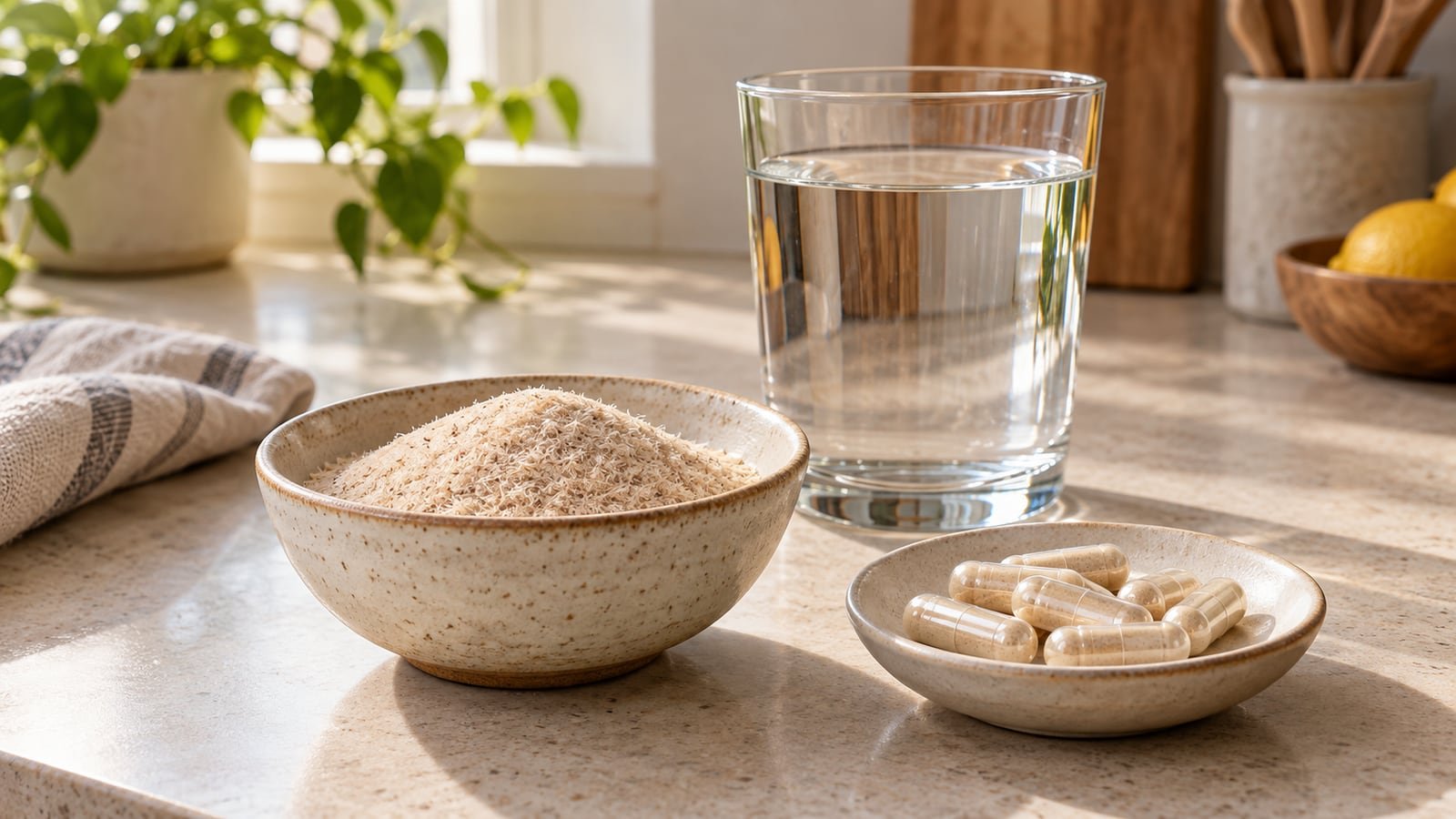
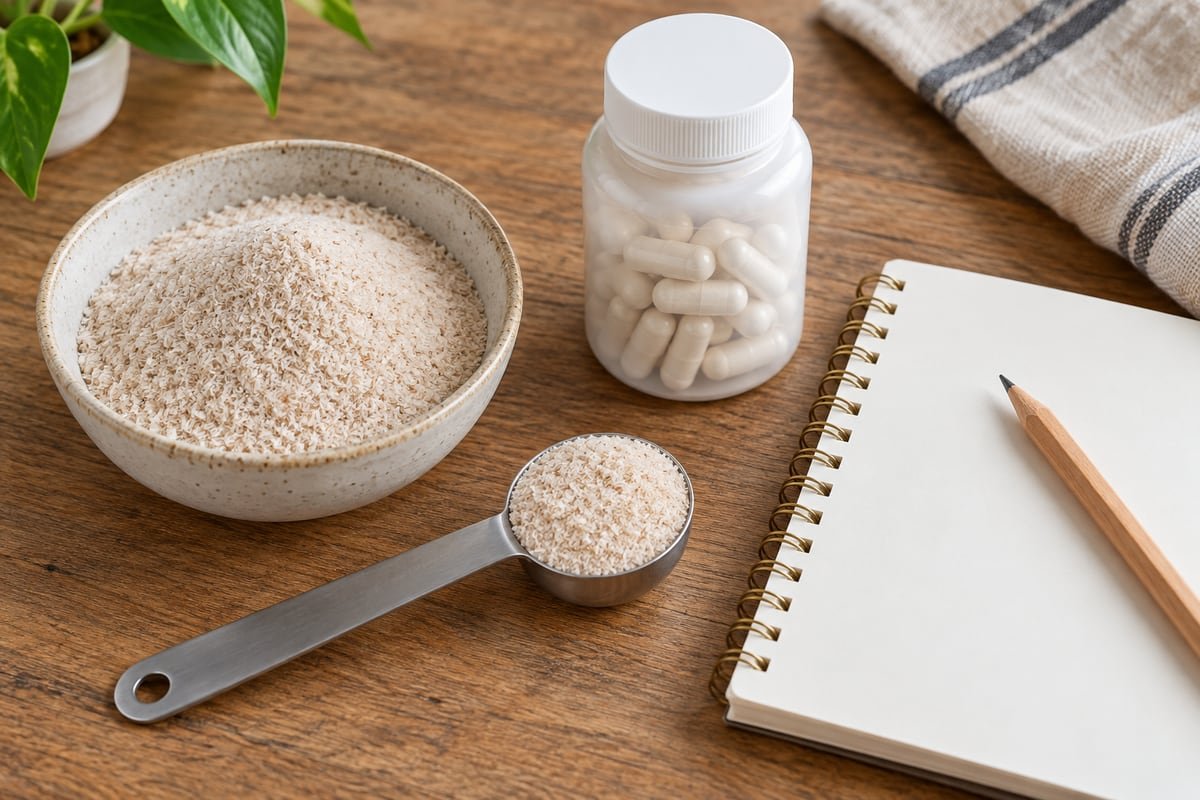
Psyllium is fiber from seed husks. Mixing it with liquid produces a thickened mixture. Capsules contain the husk inside a shell; loose powder requires measuring and mixing. The shell does not turn psyllium into a more powerful appetite ingredient.
What changes most is the amount in a serving and the effort involved. A capsule can be convenient, but several capsules may provide less dietary fiber than one serving of a particular powder. That is a comparison between labels, not proof that every powder beats every capsule.
| Buying question | Capsules | Powder |
|---|---|---|
| Do you dislike a thick drink? | Avoids the drink’s texture | Texture may be the main drawback |
| Do you want fewer units per serving? | Check the complete capsule count | One measured serving may be simpler |
| Will you use it away from home? | Portable, but still needs liquid | Needs a suitable glass and mixing |
| Is swallowing difficult? | Do not assume capsules are suitable | Powder is not an automatic safe alternative |
Both formats require adequate liquid. If you have difficulty swallowing, get medical advice rather than choosing a different form yourself. For a broader starting framework, use our guide to choosing diet supplements safely.
Fullness research is not a weight-loss guarantee
There is evidence that psyllium can affect appetite. In two short randomized crossover trials published in 2016, healthy volunteers reported improved fullness and reduced hunger with psyllium compared with placebo. The studies lasted three days per treatment period and included researchers affiliated with Procter & Gamble.
Those details limit the conclusion. Feeling fuller in a short study does not establish lasting weight loss, and the trials were not a direct comparison of the capsule and powder products below. Their results do not justify saying that one retail format suppresses appetite better at an equivalent amount.
Across fiber research, results vary. A systematic review of short-term fiber studies found that most interventions did not significantly improve appetite or reduce food intake. That review covered many fiber types, so it should not be treated as a verdict on every psyllium product either.
The useful expectation is modest, uncertain help with fullness alongside ordinary meals. Psyllium does not replace treatment for obesity, and a bowel movement is not evidence that body fat has been lost. Our explanation of GLP-1 supplement claims provides context for products marketed as prescription alternatives.
Read three different numbers on the label
1. Total serving weight
A scoop’s weight may include psyllium plus flavorings, sweeteners, or other ingredients. Nine grams of a finished product does not automatically mean nine grams of dietary fiber. Likewise, a large bottle does not tell you how many useful servings it contains.
2. Psyllium husk amount
This is the weight of the ingredient. A capsule advertised as “500 mg” may contain 0.5 gram of psyllium husk. Multiply by the capsules in the labeled serving before comparing it with a powder. Do not confuse milligrams with grams: 1,000 mg equals 1 g.
3. Dietary fiber and soluble fiber
Dietary fiber is a separate label entry. Soluble fiber may be listed beneath it. Use the same field on both products: dietary fiber against dietary fiber, or soluble fiber against soluble fiber. Comparing one product’s husk weight with another’s soluble fiber produces a misleading result.
For example, the current NOW powder label lists a 9 g tablespoon with 7 g dietary fiber. Its 500 mg capsule label lists three capsules with 1.5 g psyllium and 1.1 g dietary fiber. These are product-specific figures checked October 16, 2026; recheck your package.
One powder serving therefore lists roughly six times the dietary fiber of one three-capsule serving. That calculation explains the difference; it is not an instruction to swallow six servings of capsules. The products have different usage directions. Our supplement label-reading checklist helps with the rest of the panel.
Choose the routine you can actually repeat
Powder may suit you if you can mix it at home, tolerate its consistency, and follow the measurement and liquid instructions. Its main practical advantage is getting the labeled amount without swallowing multiple capsules. Its drawbacks are preparation, cleanup, and a texture that changes as it stands.
Capsules may suit you if avoiding texture matters more than getting a larger amount in one serving. They can fit a travel routine, provided you have enough liquid available. Count the full daily capsule burden alongside your existing medicines and supplements before buying.
Neither may suit you if swallowing is difficult, your clinician advises against bulk-forming fiber, or you cannot follow the fluid directions. A product is not a bargain if using it safely is impractical. Do not choose capsules because they appear to need less water.
Keep other fiber products separate in your comparison. A gummy or clear-mixing powder may use a different ingredient. Its pleasant texture does not prove that psyllium research applies to it. For an alternative ingredient, see our glucomannan evidence guide; its findings should not be transferred to psyllium.

Compare value without chasing a research dose
Price per capsule is rarely a useful comparison with price per scoop. First calculate servings per container. Then divide the current purchase price by those servings to find cost per labeled serving. If the labels disclose dietary fiber, divide again by dietary fiber grams per serving.
For instance, an imaginary container costing $24 with 60 servings costs $0.40 per serving. If each serving provides 4 g dietary fiber, the cost is $0.10 per gram. These are invented arithmetic examples, not prices or specifications for either recommended product.
Use that figure as a shopping aid, not a dosage target. Two products can have different directions, tolerability, and intended uses. A lower cost per gram is not better value if you dislike the format enough to abandon it. Start with a manageable package rather than buying a large supply before you know it suits you.
Two Amazon options to compare
Affiliate disclosure: This article contains affiliate links. As an Amazon Associate I earn from qualifying purchases. If you buy through these links, the site may earn a commission. These are label-based comparisons; we have not personally tested these products.
NOW Foods Psyllium Husk Powder, 24 ounces
This plain powder is an option for adults who prefer measuring and mixing to swallowing multiple capsules. It suits a home routine and makes the fiber-per-serving comparison straightforward. The trade-off is texture and preparation: the manufacturer currently directs mixing in at least 12 ounces of water or juice and consuming immediately.
Check the actual container for current ingredients, warnings, and directions, including allergen information. Do not use it as a dry spoonful or make it into a concentrated paste. View NOW Psyllium Husk Powder on Amazon.
NOW Foods Psyllium Husk Caps 500 mg, 500 capsules
This option suits adults who can swallow capsules comfortably and want to avoid a mixed drink. The buying consideration is the modest fiber amount per labeled serving and the number of capsules involved. A large capsule count on the bottle does not equal the same number of servings.
Read the package directions before deciding whether the daily routine fits. Capsules still need a full glass of liquid; convenience does not remove that requirement. Compare the seller, exact variant, and current label at checkout. Neither listing establishes that the product causes weight loss. View NOW Psyllium Husk Capsules on Amazon.
Use the label’s liquid and medication precautions
Never dry-scoop psyllium. MedlinePlus psyllium guidance calls for at least 8 ounces of liquid when taking it; individual products can require more. Follow your product’s larger amount where specified. If you have a prescribed fluid restriction, ask your clinician before starting.
Medication spacing is not one universal interval. Ask a pharmacist to check every medicine you take. MedlinePlus specifically advises not taking digoxin, salicylates such as aspirin, or nitrofurantoin within three hours of psyllium. Do not move or stop prescribed medicines on your own to fit a supplement around them.
Get advice first if pregnant or breastfeeding, taking medication, or managing a medical condition. Intestinal blockage, rectal bleeding, and swallowing problems need medical attention rather than an appetite experiment. Seek urgent help for breathing or swallowing difficulty after taking psyllium; severe pain or vomiting also needs prompt assessment.
Introduce fiber gradually according to the label rather than starting several new products together. If using psyllium as a laxative, MedlinePlus advises against taking it longer than one week unless directed by a doctor. Longer-term use for another goal should be discussed with your clinician.
Keep food at the center of the plan
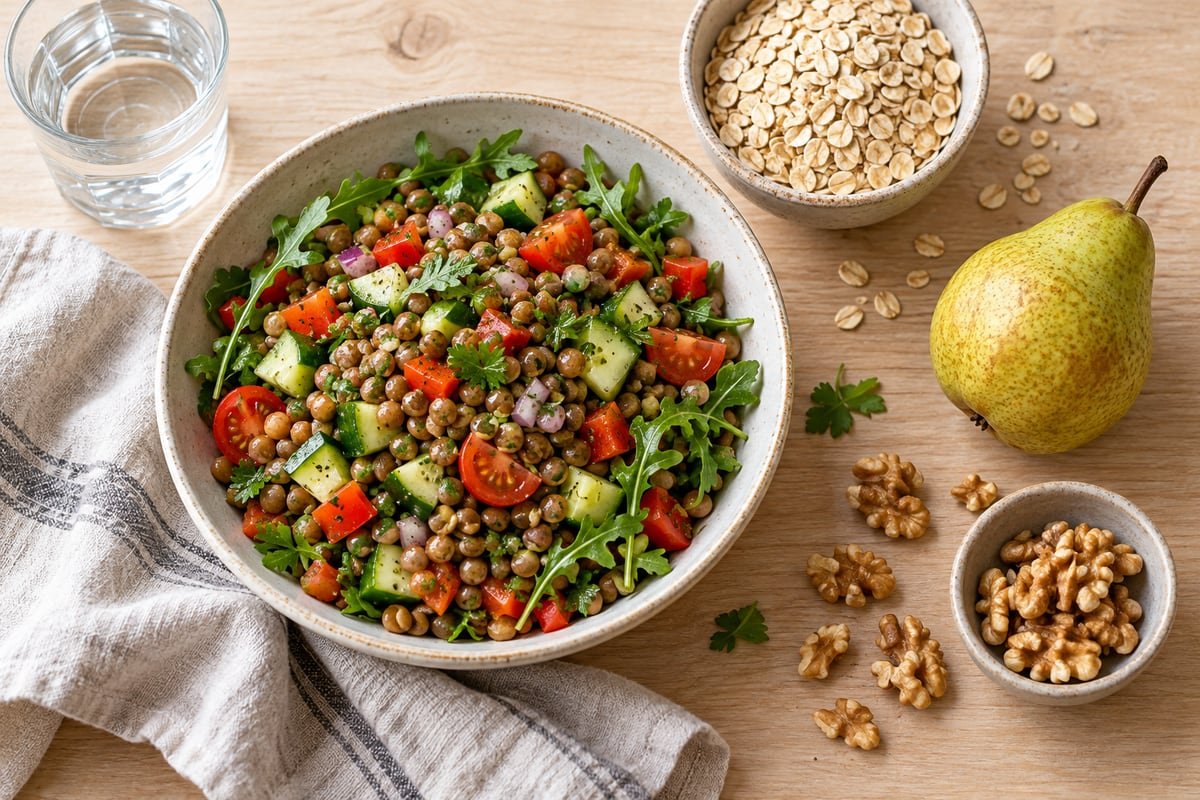
Before adding a supplement, look at what you eat on a normal day. Could breakfast include oats and fruit? Could lunch include beans or lentils? Those changes offer foods you can build a meal around, while a fiber capsule only supplies what its label lists.
In this short Mayo Clinic video, dietitian Kate Zeratsky explains everyday fiber sources and why to increase fiber gradually with adequate water. It supports the food-first approach; it does not compare the two products or prove an appetite benefit.
Make the purchase decision in five minutes
Put the two labels side by side. Identify the ingredient, full serving size, dietary fiber amount, liquid requirement, and any medicine questions. Choose powder if its preparation fits your day; choose capsules if texture is the sticking point and their serving size meets your needs.
Then judge the routine by comfort, practicality, and whether it helps you maintain balanced meals. Do not escalate the dose because hunger still exists. If hunger feels persistent or difficult to manage, seek individualized advice instead of stacking more supplements.
Frequently asked questions
Are psyllium capsules as good as powder for appetite?
Both supply psyllium, but labeled amounts differ. The evidence reviewed here does not establish that these retail capsules and powder produce equal appetite effects gram for gram. Compare the actual ingredient and fiber amounts, and choose a format you can use safely.
How many psyllium capsules equal a tablespoon of powder?
There is no universal conversion. Capsule strength, powder density, and serving sizes vary. Compare the same label field on both products. Do not increase capsules beyond their directions to match a powder serving or a clinical study.
Should I take psyllium before meals for hunger?
Some short appetite trials used psyllium before meals, but that does not create a universal schedule. Follow your product label and ask a pharmacist about medication timing. Do not copy a trial’s dose or timing without checking whether it suits you.
Can psyllium help me lose belly fat?
Psyllium is not a targeted belly-fat treatment. Feeling fuller does not guarantee lower calorie intake or lasting weight loss. Changes in bowel contents can change scale weight without showing fat loss. Persistent weight or appetite concerns deserve individualized advice.
Do psyllium capsules still need water?
Yes. Capsules do not remove the liquid requirement. Follow the package directions, which may require a full glass or more. Do not use psyllium if you have difficulty swallowing without medical advice; seek urgent help for breathing or swallowing problems afterward.
Are fiber gummies the same as psyllium powder?
Not necessarily. Gummies can use other fiber ingredients. Check the ingredient list and dietary fiber per complete serving rather than assuming that the format or brand makes products equivalent. Research on psyllium cannot automatically establish the benefits of another fiber.