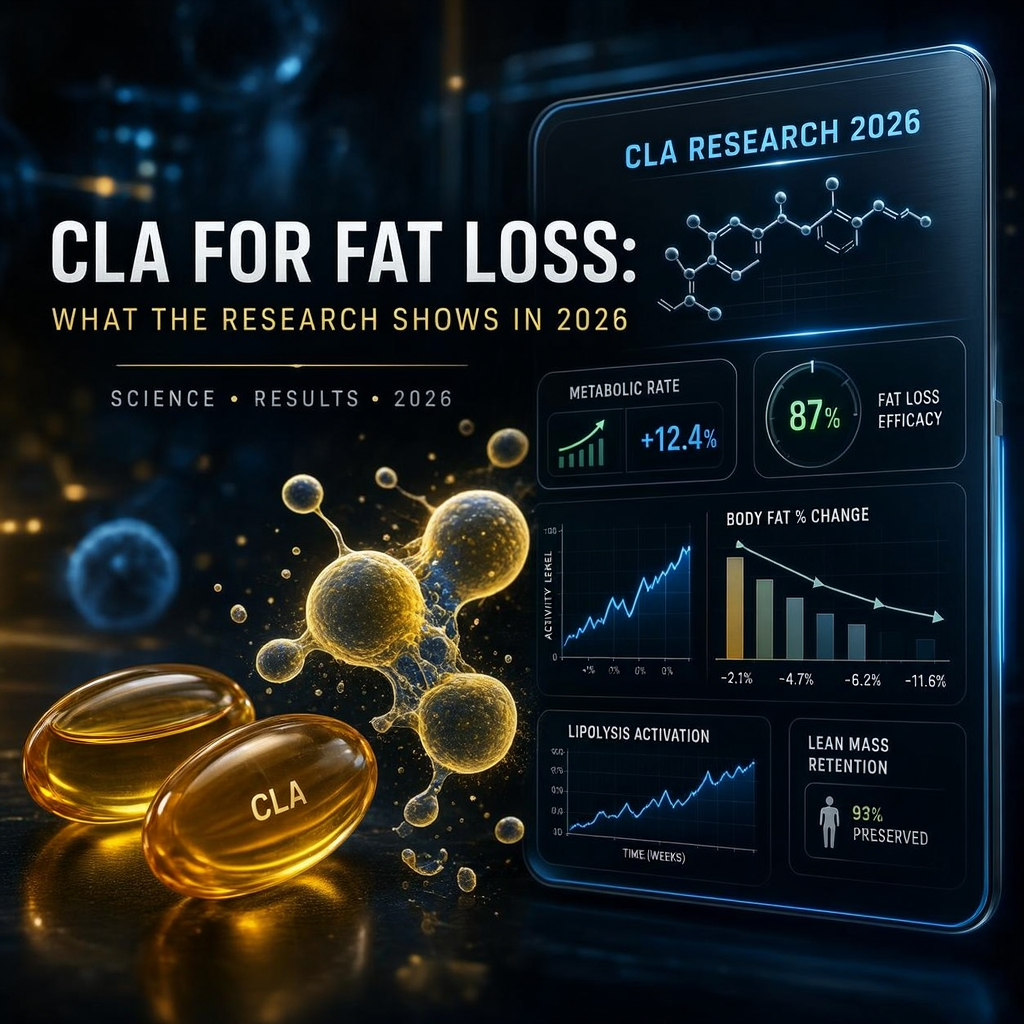
CLA for Fat Loss: The Ultimate Research Breakdown for 2026
You’ve seen the bottles. “Melts belly fat.” “Clinically proven.” “The natural fat burner.” Maybe you even bought one. Maybe it did nothing.
Here’s the truth about CLA for fat loss. It’s not magic. It’s not a scam either. The real story sits in a messy middle, and that’s exactly where the supplement industry doesn’t want you to look.
Let’s fix that. By the end of this post, you’ll know what CLA can actually do, what it can’t, and whether it’s worth your money.
What Is CLA (Conjugated Linoleic Acid)?
CLA stands for conjugated linoleic acid. It’s a type of fat found in nature.
You already eat it. It shows up in beef and dairy from grass-fed animals. It’s a normal part of a normal diet.
The supplement version is different. It’s made in a lab and sold as capsules. Most bottles contain a 50/50 mix of two active forms, called isomers.
One of those forms does most of the fat-related work. Its name is trans-10, cis-12. Keep that name in mind. It matters later.
So far, so good. A natural fat that might help you lose fat sounds great. But this is where the marketing and the science start to split apart.
Why CLA Works for Fat Loss in Animals
Here’s why CLA got famous. In animals, it worked really well.
Feed CLA to mice, and they lose body fat fast. The results were dramatic and repeatable. Scientists got excited, and honestly, they had a reason to be.
CLA seems to change how fat cells behave. It appears to block fat from getting stored. It may also nudge the body to burn more.
That’s a real mechanism. It’s not made up.
But here’s the catch that changed everything. Mice are not people. A dose that reshapes a mouse doesn’t do the same thing in a human body. The jump from lab animals to real humans is where CLA lost most of its shine.
Does CLA Work for Fat Loss in Humans?
This is the part that matters to you. So let’s be precise.
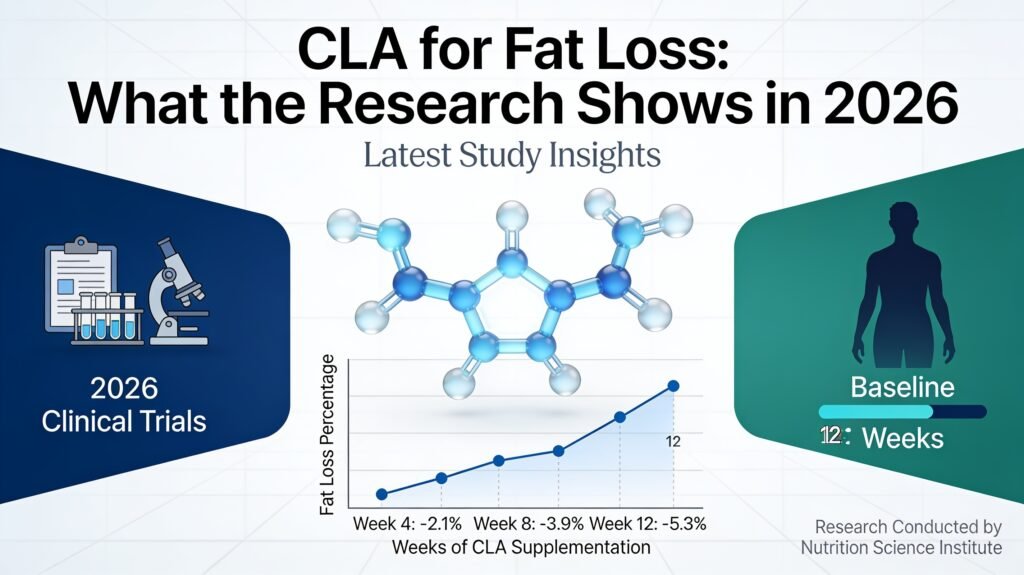
Does CLA work for fat loss? Only slightly. Human studies show CLA produces a modest fat loss of about 0.1 kg per week at a dose of 3.2 grams daily. But the highest-quality trials find little to no effect, and the results don’t hold up long-term. For most people, CLA isn’t worth the cost.
Now the details. Researchers have run many human trials. Then they pooled the results in big reviews called meta-analyses.
One of the most-cited reviews, a meta-analysis in the American Journal of Clinical Nutrition, looked at 18 human trials. Its finding was honest and small. At about 3.2 grams a day, CLA produced a modest loss in body fat.
Read that word again: modest.
We’re talking about roughly 0.1 kilograms of extra fat loss per week versus a placebo. That’s about a quarter of a pound. Not per day. Per week.
A 2024 dose-response review in the British Journal of Nutrition put a finer point on it. It found a small but real improvement in body composition markers.
But then it dropped the bomb. When researchers looked only at the highest-quality studies, the fat-loss effect failed to show up.
Let that sink in. The better the study, the smaller the effect gets.
Why CLA Study Quality Changes the Answer
You might be thinking, “A study is a study.” It’s not. And this is the single most important idea in this whole post.
Weak studies have problems. Small groups. Short timelines. Loose methods. These flaws can make a supplement look better than it really is.
Strong studies fix those problems. They use more people. They run longer. They control for other factors.
So when the strong studies show little or no effect, that’s a huge red flag.
Here’s a simple way to think about it:
- Weak studies say: CLA might help a little.
- Strong studies say: We can’t really prove CLA helps.
When the best evidence points to “not much,” the honest answer is “not much.”
Does CLA Keep Fat Off Long-Term?
Let’s say you don’t care about a tiny effect. You just want to keep fat off for good. Fair.
Bad news. CLA doesn’t seem to help with that either.
One trial ran for a full year. It tested whether CLA could stop people from regaining weight and fat.
It couldn’t. CLA did not prevent weight or body fat from coming back. The effect was tiny and not even statistically meaningful.
This is the opposite of what you want from a fat-loss tool. You want something that helps you win the long game. CLA didn’t.
CLA Side Effects and Safety Risks
Now for the part the sales pages skip entirely. CLA isn’t just “meh.” For some people, it may carry real downsides.
Some studies found troubling effects from the active isomer. Remember trans-10, cis-12? In certain trials, it made things worse.
Here’s what researchers have reported:
- Higher insulin resistance in men with belly fat. That’s a step toward blood sugar problems.
- Higher fasting glucose in the same group. Also not good.
- Higher C-reactive protein. That’s a marker of inflammation in the body.
Not everyone gets these effects. The research is mixed, and doses vary. But “might not work AND might raise your inflammation” is a rough trade.
You’d be paying money for a small maybe, plus a side of risk. That’s a hard sell once you see the full picture.
Is CLA a Scam or Does It Have Real Benefits?
No, it’s not a scam. And this is where honesty cuts both ways.
CLA is not snake oil. It has real mechanisms. It shows real, tiny effects in pooled data. One meta-analysis in women found CLA linked to about 1.2 kg less body weight, along with small drops in BMI and body fat.
But “real and tiny” is not “worth it” for most people.
Think about the math. You’d spend money every month. You’d swallow capsules every day. And your reward might be a fraction of a pound over many weeks, if anything at all.
Meanwhile, that same effort spent on sleep, protein, or a daily walk would beat CLA easily. And those cost nothing.
Who Should Consider CLA Supplements?
Let’s be fair to the true believers. Is there anyone with a reasonable case to try it?
Maybe. A few groups come to mind:
- People who’ve nailed the basics. If your diet, sleep, and training are already dialed in, tiny edges might interest you.
- People chasing marginal gains. Some folks want every 1% they can get, and they accept the cost.
- People who tolerate it well. No blood sugar issues, no inflammation flare-ups, no stomach upset.
Even then, keep your expectations low. The effect, if it comes, will be small. And watch your metabolic markers if you have any risk factors.
For everyone else? Your money has better homes.
What Actually Works for Fat Loss Instead of CLA
You came here to lose fat. So let’s not leave you empty-handed.
The boring stuff wins. It always has. Here’s where your effort pays off far more than any CLA capsule:
- Eat enough protein. It keeps you full and protects muscle.
- Move most days. Walking counts. Consistency beats intensity.
- Sleep seven to nine hours. Poor sleep sabotages fat loss.
- Manage your calories. A small, steady deficit does the heavy lifting.
- Lift something heavy. Muscle changes your whole metabolism.
None of these fit in a bottle. That’s the point. Real results come from habits, not pills. CLA can’t shortcut any of this. Nothing can.
The Bottom Line: Is CLA for Fat Loss Worth It?
So here’s the deal. CLA for fat loss works wonders in mice, barely moves the needle in humans, does nothing for the long term, and may raise inflammation for some people. That’s not a fat-burner. That’s a footnote.
The ad promises you a shortcut. The science, especially the strongest science, says there isn’t one in that bottle. Trust the data over the label.
Skip the CLA. Take this month’s supplement budget and spend it on real food, or a decent pair of walking shoes. Then pick one habit from the list above and start it today. That’s the plan that actually pays you back.