
Protein on GLP-1: How Much You Need to Keep Muscle
Affiliate disclosure: Some links in this article are Amazon affiliate links. If you buy through them, we may earn a small commission at no extra cost to you. Images are AI-generated illustrations created in Canva, not product photographs. This guide is educational and does not replace advice from your prescriber or a registered dietitian.
The appetite drop is the whole point of a GLP-1 medication. The trouble is that it doesn’t choose what to cut. When researchers looked at real food logs from people on semaglutide and tirzepatide, average intake landed near 0.6 grams of protein per kilogram of body weight a day, roughly 38% of the 1.6 g/kg target many clinicians now use.
That gap is why protein on GLP-1 treatment has become the first nutrition question good prescribers ask. It decides how much of the weight you lose is fat and how much is the muscle that keeps you strong, steady on the stairs and able to hold your results when the dose changes.
Below you’ll get a target you can actually calculate, five rules for hitting it when four bites feel like a full meal, and something most guides skip: how to time protein around the new GLP-1 pills, because the Wegovy tablet and Foundayo follow very different rules.
Table of Contents
Why protein on GLP-1 drops further than you expect
Most people assume their protein on GLP-1 meds is low because meat or dairy stopped appealing. The data points somewhere else. In a real-world dataset presented at the 2026 European Congress on Obesity, covering 116 GLP-1 users and 5,741 days of food logs, protein still made up about 20% of calories, the same share as non-users. What collapsed was the total: users averaged 1,102 calories a day and skipped more meals at breakfast, lunch and dinner. Eighty-eight percent fell below 1.2 g/kg, as Barbell Medicine’s summary of the abstract lays out.
A peer-reviewed study found the same pattern earlier. GLP-1 users who kept three-day food records ate about 1,763 calories with 17.5% from protein, and the authors judged that intake too low for a calorie-reduced diet.
So the fix for low protein on GLP-1 isn’t a better macro ratio. It’s protecting a fixed number of grams while everything else on the plate shrinks.
How much muscle is really on the line
Body-scan substudies give the clearest answer. In STEP 1, roughly 39% of the weight lost on semaglutide was lean mass. In the SURMOUNT-1 substudy, tirzepatide users lost 21.3% of body weight and about a quarter of that loss was lean mass.
Two caveats keep this from being a horror story. “Lean mass” on a DXA scan includes water, organs and connective tissue, not only skeletal muscle. And fat fell faster than lean tissue in both trials, so overall body composition improved.
That’s why protein on GLP-1 therapy still matters despite those caveats. Lose 50 pounds with a quarter of it lean tissue and you’ve shed about 12 pounds of non-fat mass. For a woman in her late 50s who is already losing muscle to age, that can show up as weaker grip, slower stairs and a harder time keeping weight off later. If that’s you, our guide to diet pills for women over 40 covers the hormonal side of the same problem.
Your protein on GLP-1 target, calculated
Three credible sources land in the same zone for protein on GLP-1 medication:
- The 2025–2030 Dietary Guidelines for Americans set an adult target of 1.2–1.6 g per kg of body weight daily, double the old 0.8 g/kg allowance.
- A 2025 joint advisory from four obesity and nutrition societies notes that 1.2–1.6 g/kg has been proposed during active weight loss, while admitting there’s no consensus on which body weight to use.
- The JAMA Internal Medicine patient page suggests 1.0–1.5 g/kg for moderately active adults, 20–30 g at each meal, and shakes with at least 20 g when appetite is very low.
Step 1: Use adjusted body weight if you carry a lot of extra weight
Multiply a 260-pound scale weight by 1.6 and you get 189 g a day, a number almost nobody on a GLP-1 can eat. A clinical review of supplements during GLP-1 therapy recommends adjusted body weight once you’re above 115% of ideal weight, then recalculating as you lose.
A common dietitian formula is: ideal weight + 0.25 × (current weight − ideal weight). Take Maria, 5’5″ and 230 lb (104 kg). Her ideal weight by the standard Devine formula is about 57 kg, so her adjusted weight is roughly 69 kg. At 1.2–1.6 g/kg, that’s 83–110 g a day instead of 166 g. One plan she can follow; the other she quits by Thursday.
| Example person | Adjusted weight | Daily protein (1.2–1.6 g/kg) |
|---|---|---|
| Woman, 5’5″, 180 lb | ≈ 63 kg | 76–101 g |
| Woman, 5’5″, 230 lb | ≈ 69 kg | 83–110 g |
| Man, 5’10”, 200 lb | ≈ 78 kg | 93–124 g |
| Man, 5’10”, 260 lb | ≈ 84 kg | 101–135 g |
Step 2: Split the total into doses you can finish
Protein on GLP-1 works best in doses, not one big dinner. A 95 g target becomes three 30 g anchors plus a small snack, or four 20–25 g mini-meals. If you’re over 60 or rarely active, aim for the top of the 20–30 g per-meal range, because older muscle needs a bigger dose to respond.
When your number should be lower
Chronic kidney disease flips the advice. People with reduced kidney function are often told to stay near 0.6–0.8 g/kg. If you have CKD, diabetic kidney disease or a low eGFR on recent labs, get your number from your nephrologist or dietitian, not from a table online.
5 rules for eating protein on GLP-1 when appetite disappears
1. Spend your best appetite on protein
Many people find hunger is strongest early in the day, before the stomach has spent hours holding food. Put your largest protein serving there: three eggs plus a 6-ounce cup of plain Greek yogurt lands around 35 g before you’ve thought about lunch. If evenings are your better window, flip the plan.
2. Eat the protein first, then everything else
Fullness arrives within a few bites. Plate the chicken or fish alone, finish it, then add the vegetables and starch. On a bad day you’ll still have eaten the part that protects muscle. Of every habit here, this one does the most for protein on GLP-1 medication.
3. Choose protein per calorie, not protein per bite
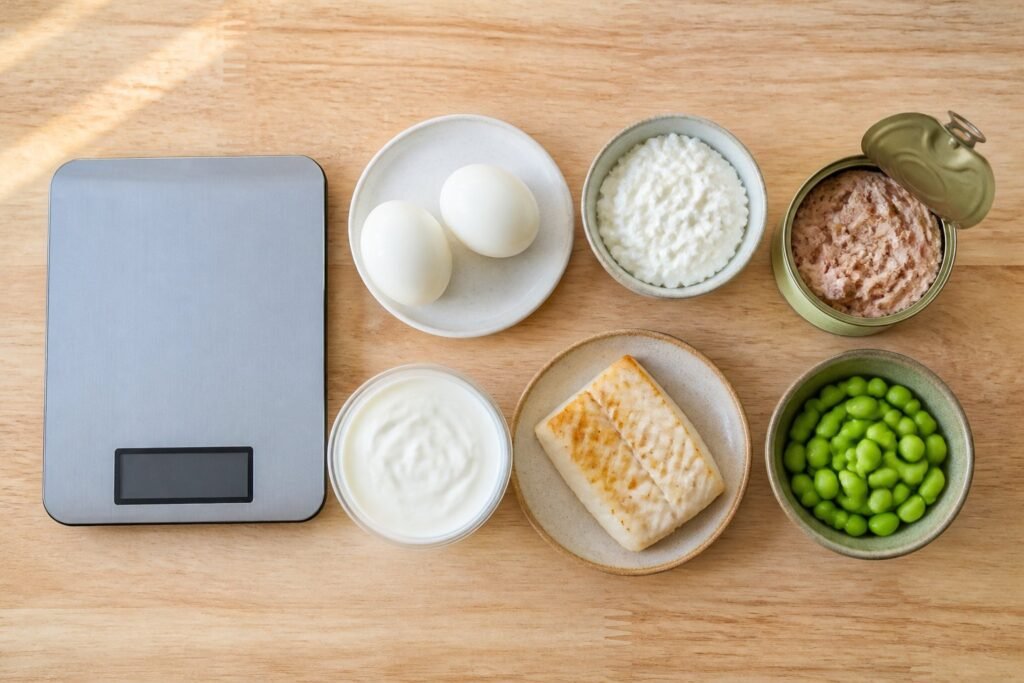
When total calories are capped by appetite, fatty protein crowds out grams you need. Greasy food also tends to make GLP-1 nausea worse. These lean options give you the most protein for the room they take up:
| Food | Portion | Protein (approx.) | Calories (approx.) |
|---|---|---|---|
| Chicken breast, cooked | 3 oz | 26 g | 140 |
| Tuna in water, drained | 1 can (about 4 oz) | 25 g | 120 |
| Plain nonfat Greek yogurt | 6 oz | 17 g | 100 |
| Low-fat cottage cheese | ½ cup | 13 g | 90 |
| Liquid egg whites | ½ cup | 13 g | 60 |
Eyeballing portions is where most plans drift. Weighing your protein for two weeks recalibrates your eye fast. The Etekcity Food Kitchen Scale reads in 1-gram steps and costs about as much as a lunch, which is all a protein audit needs.
4. Keep a liquid backup in the fridge
Shakes aren’t cheating. They’re the most reliable way to rescue protein on GLP-1 low-appetite days, and the JAMA guidance names them for exactly that. Cold and sipped over 30–45 minutes usually sits better than gulped. Pick products that hit 20 g or more per serving and have been tested for contaminants, because a Consumer Reports investigation found plant-based powders averaged nine times the lead of dairy-based ones.
- Premier Protein 100% Whey Powder (Chocolate): 30 g of whey per scoop for about 150 calories, and Consumer Reports’ January 2026 follow-up testing found it low in lead and suitable for daily use.
- OWYN Pro Elite 32g Shake (Chocolate): a ready-to-drink, dairy-free option for people who can’t tolerate milk proteins, and it appears on Consumer Reports’ low-lead list.
- Isopure Zero Carb Unflavored Whey Isolate: 25 g per scoop with no flavor, so you can stir it into soup, oatmeal or yogurt when sweet shakes turn your stomach. It wasn’t part of CR’s testing, so rotate it rather than rely on it alone.
Shakes plus a smaller appetite can slow things down. If that happens, add soluble fiber gradually; our comparison of psyllium capsules vs powder explains which form is easier to take with water.
5. Lift something twice a week
Protein without a training signal mostly gets burned for energy. The JAMA page recommends strength work two to three times a week for about 30 minutes using bands, weights or bodyweight. Squats, rows and push-ups against a counter are enough to start, and they matter more than squeezing out your last 10 grams. Strength work is what turns protein on GLP-1 into muscle you keep.

Timing protein around GLP-1 pills: Wegovy tablet vs Foundayo
Weekly injections never cared when you ate. The new pills do, at least one of them, and that changes how you plan protein on GLP-1 pills.
Wegovy pill: protein on GLP-1 tablets waits 30 minutes
The Wegovy tablet is taken on an empty stomach first thing in the morning with no more than 4 ounces of water. You then wait at least 30 minutes before eating, drinking anything else or taking other oral medicines, according to Novo Nordisk’s dosing instructions. That includes your shake and your coffee. A workable morning looks like this:
- 6:45 a.m. Tablet with a small sip of plain water.
- 7:15 a.m. or later: First food, protein first. A shake on the commute counts.
- With breakfast or lunch: Vitamins and other supplements, never alongside the tablet.
Don’t “save time” by mixing protein powder into the tablet water. Taking it with anything but a little water reduces how much semaglutide gets absorbed.
Foundayo: no food window, different interactions
Foundayo (orforglipron), which the FDA approved on April 1, 2026, is a small-molecule pill that can be taken without food or water restrictions, so protein timing is about appetite, not absorption. Its interaction list is different, though: St. John’s wort can speed its breakdown and make it less effective, so mention every supplement to your pharmacist.
If you’re still weighing these options against over-the-counter products, our breakdown of OTC vs prescription weight loss pills lays out what each class can realistically do.
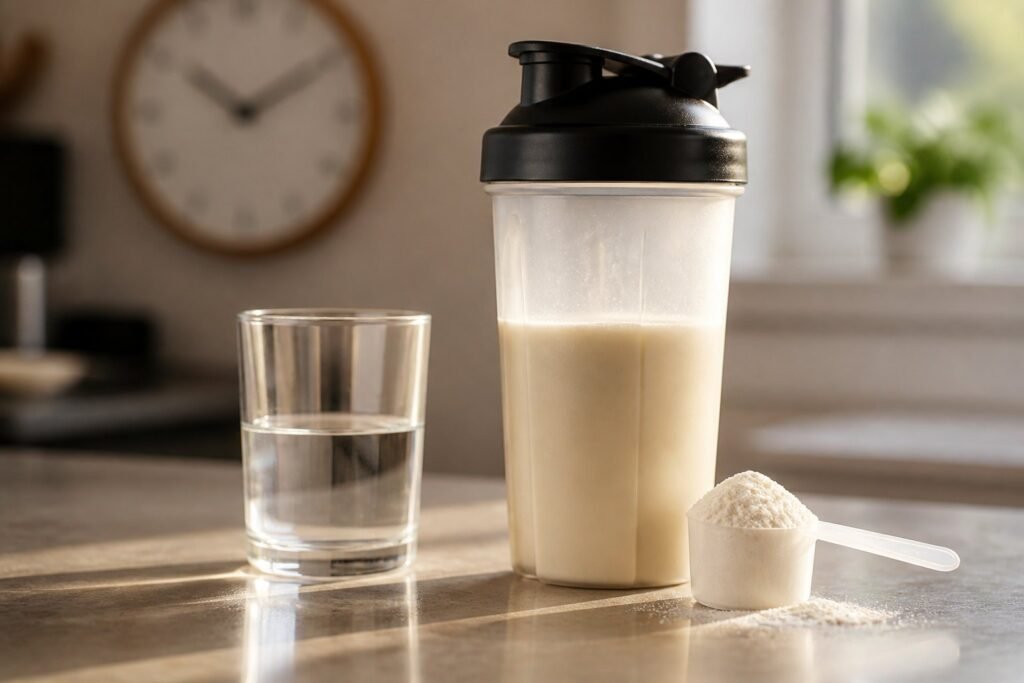
Picking a protein powder when your stomach is touchy
A powder is the easiest patch for protein on GLP-1 days, but the wrong tub adds nausea, sugar or contaminants. Four filters cover most of the risk:
- Whey isolate over concentrate if dairy gives you trouble; most of the lactose is filtered out.
- Skip collagen as your main source. It’s an incomplete protein low in leucine, the amino acid that switches on muscle building.
- Ignore “GLP-1 booster” blends. A powder promising to mimic your medication is marketing, not dosing. Our look at what GLP-1 supplement labels won’t say shows how those claims get past regulators.
- Read the panel, not the front. Grams per serving, scoops per serving and added sugar matter more than any badge. Use our guide on how to read a supplement label if a tub lists a proprietary blend.
Video: a dietitian’s low-effort protein fixes
Registered dietitian Ana Reisdorf, who takes a GLP-1 herself, walks through the easiest ways to raise protein on GLP-1 medication when meat sounds unappealing and a few bites make you full.
Frequently asked questions
What happens if you don’t get enough protein on GLP-1?
More of the weight you lose comes from lean tissue instead of fat. Over months that can mean weaker strength, more fatigue, slower recovery and a lower metabolic rate, which makes regain easier if you stop or lower the dose. Hair shedding and feeling cold are also common complaints when total intake is very low.
Should you eat high-protein on GLP-1 medication?
Yes, relative to how little you’re eating overall. Federal guidelines now suggest 1.2–1.6 g per kg of body weight daily, and on a GLP-1 that usually means making protein the first and largest part of every meal. If you carry a lot of extra weight, base the number on adjusted body weight so the target stays realistic.
Can you eat too much protein on GLP-1?
For most healthy adults, intakes up to about 1.6 g/kg are well tolerated and very hard to overshoot on a suppressed appetite. The real exceptions are people with chronic kidney disease or reduced kidney function, who usually need a lower, individualized target from their doctor or dietitian.
Can I drink a protein shake right after my Wegovy pill?
No. The Wegovy tablet must be taken with no more than 4 ounces of plain water, and you need to wait at least 30 minutes before food, other drinks, supplements or medicines. Plan protein on GLP-1 tablets for 30 minutes or more after the dose. Foundayo and the weekly injections don’t have this food window.
Is it okay to use protein powder on a GLP-1?
Yes. Powder is a practical way to cover protein on GLP-1 days when solid food won’t go down, and the JAMA Internal Medicine patient guidance recommends shakes with at least 20 g of protein when appetite is very low. Choose a whey isolate or a dairy-free shake with Consumer Reports or third-party heavy-metal testing, and sip it slowly if you feel nauseated.
How much protein per meal on GLP-1?
For protein on GLP-1, aim for 20–30 g at each meal, and closer to 30–40 g if you’re over 60 or not very active. If three meals isn’t realistic, spread your total across four or five smaller eating windows, and put the largest serving where your appetite is best.
Start with one number this week
Calculate your target with adjusted body weight, put your biggest serving at the meal where hunger still shows up, and keep one shake ready for bad days. Track protein on GLP-1 for 14 days before changing anything else. If the scale stalls along the way, our guide to breaking a weight-loss plateau picks up where this one ends, and your prescriber or a registered dietitian can fine-tune the number for your labs.