LeanBean vs PhenQ: The Disappointing Truth the Evidence Says
Last updated: August 2026 · Reviewed against published clinical research (sources listed at the end). This article contains no affiliate links.
Searching “LeanBean vs PhenQ” usually drops you into a wall of reviews that all want the same thing: your click and their commission. This honest comparison of the two fat burners does something different. The goal here is to help you make a smart choice — even if that choice is to skip both. Let’s get into the ingredients, the cost, and what the science really shows.
Table of Contents
What LeanBean and PhenQ actually are
LeanBean and PhenQ are dietary supplements sold as “fat burners.”
Here’s the key thing to understand. Neither one is a drug. Neither is approved by the FDA for weight loss.
In the US, supplements don’t get tested for safety or effectiveness before they hit the shelf. Companies can make bold claims. Nobody checks them first.
That doesn’t make these products dangerous by default. But it does mean you can’t trust the marketing on its own.
LeanBean vs PhenQ ingredients: what’s inside each one
The pills are mostly built from the same handful of common ingredients. Let’s look at them.
LeanBean ingredients:
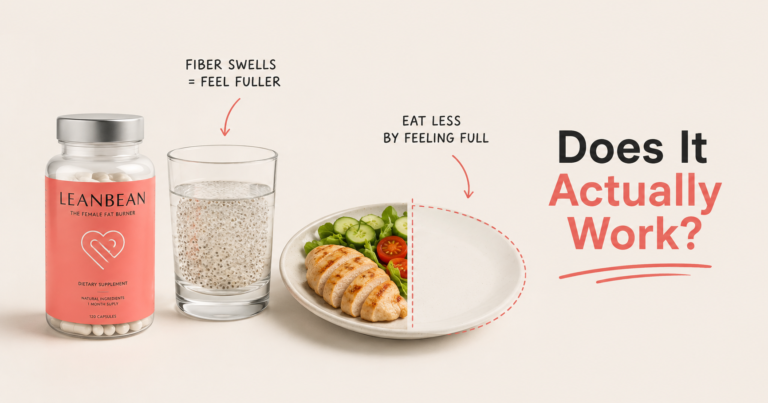
- Glucomannan (a fiber that expands in your stomach)
- Small doses of vitamins and minerals
- Green coffee and other plant extracts
- A little caffeine (less than PhenQ)
PhenQ ingredients:
- Caffeine (a bigger dose)
- A blend called “a-Lacys Reset” (a mix the company brands itself)
- Capsimax (from chili peppers)
- Chromium and a few other extracts
Notice the overlap. Fiber, caffeine, plant extracts, some vitamins. That’s the core of most fat burner supplements on the market.
Do LeanBean and PhenQ actually work? What the science shows
Do fat burners like LeanBean and PhenQ actually work? On their own, barely. The best-studied ingredient is glucomannan, a fiber that may slightly reduce appetite, but the weight-loss effect is small and inconsistent. Caffeine gives a tiny, short-lived metabolism bump. No supplement replaces changes to your eating and movement.
Here’s where the honesty matters most.
The strongest evidence is for glucomannan, the fiber in LeanBean. Some studies suggest it can help you feel full, which may slightly reduce how much you eat.
But even that effect is modest. A 2021 meta-analysis pooled six trials and found glucomannan led to an average loss of about 0.96 kg — roughly two pounds. The result was statistically real but small, and the studies disagreed a lot with each other.
Caffeine can give a small bump to your metabolism. Research shows it lifts your energy burn by roughly 3% to 8% for a few hours. It’s real, but small. And your body gets used to it within a few weeks.
The rest of the ingredients? The proof is thin. Many studies are short, small, or funded by the companies selling the product.
So here’s the plain truth. Neither pill is going to melt fat off your body. Anyone who tells you otherwise is selling something.
LeanBean vs PhenQ cost: what to factor in before you buy
Both products are priced as premium supplements. That means monthly costs that add up fast.
You’re often nudged toward bulk “3-month” bundles. That locks in your spending before you know if the product does anything for you.
Compare that to the free stuff that actually works. Eating more protein. Walking. Sleeping enough. Drinking water before meals.
None of that has a commission attached. Which is probably why it doesn’t get the same hype.
LeanBean vs PhenQ: who is each one for?
If you strip away the sales language, here’s the honest split.
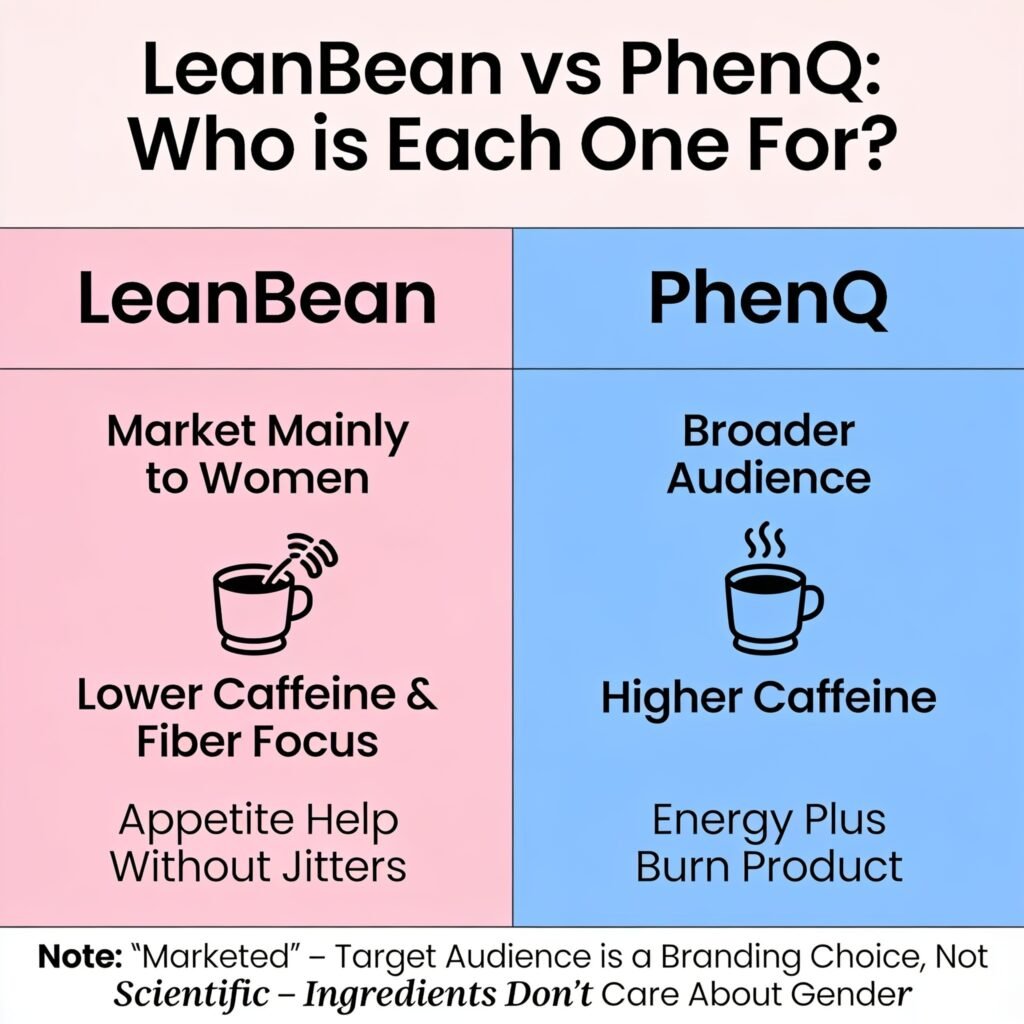
LeanBean is marketed mainly to women. Its lower caffeine and fiber focus appeal to people who want appetite help without the jitters.
PhenQ is marketed to a broader audience. Its higher caffeine makes it feel like more of an “energy plus burn” product.
But notice the word I keep using: marketed. The target audience is a branding choice, not a scientific one. The ingredients don’t care about your gender.
The honest verdict: is LeanBean or PhenQ better?
If I had to choose between the two on the evidence alone, it’s close to a coin flip.
LeanBean has the slightly better-supported main ingredient (the fiber). PhenQ has more caffeine, which some people like for energy.
But “which is better” is the wrong question. The real question is this: will either one meaningfully change your results?
And the honest answer is: probably not much, on their own.
A pill can’t out-run your daily habits. If your eating and movement don’t change, no supplement will save the day.
What I’d actually suggest instead
Here’s what I’d do in your shoes.
- Try the free stuff first. More protein, more fiber from food, more walking. Give it 4 to 6 weeks.
- If you still want a supplement, pick one, buy the smallest amount, and test it. Don’t commit to a bundle.
- Talk to a doctor or pharmacist if you take any medication. Caffeine and some extracts can interact with things.
- Track how you actually feel and what actually changes. Not the promise. The result.
The bottom line on LeanBean vs PhenQ
Strip the packaging off both and you’re looking at the same short list of common ingredients. LeanBean vs PhenQ isn’t a battle between a winner and a loser. It’s two versions of the same modest bet.
Neither is a shortcut. The company selling you the shortcut is the one that profits from the belief.
So do the boring thing that works. Fix your protein, your steps, and your sleep for six weeks first. If you still want to test one of these pills after that, buy the smallest size, not the bundle — and run it past a pharmacist before your first dose.
Sources
- Mohammadpour S, Amini MR, Shahinfar H, et al. “Effects of glucomannan supplementation on weight loss in overweight and obese adults: A systematic review and meta-analysis of randomized controlled trials.” Obesity Medicine, 2020. (6 trials, 225 participants; average weight loss ≈ 0.96 kg.) ScienceDirect
- Zalewski BM, Chmielewska A, Szajewska H. “The effect of glucomannan on body weight in overweight or obese children and adults: a systematic review of randomized controlled trials.” Nutrition, 2015. PubMed
- Onakpoya I, Posadzki P, Ernst E. “The efficacy of glucomannan supplementation in overweight and obesity: a systematic review and meta-analysis of randomized clinical trials.” Journal of the American College of Nutrition, 2014. Journal page
- Tabrizi R, Saneei P, Lankarani KB, et al. “The effects of caffeine intake on weight loss: a systematic review and dose-response meta-analysis of randomized controlled trials.” Critical Reviews in Food Science and Nutrition, 2019. (13 trials, 606 participants.) PubMed
- U.S. Food and Drug Administration. “Dietary Supplements” — on the fact that supplements are not FDA-approved for safety or effectiveness before sale. FDA.gov
This article is for general information and isn’t medical advice. Talk to a healthcare professional before starting any supplement, especially if you have a health condition or take medication.